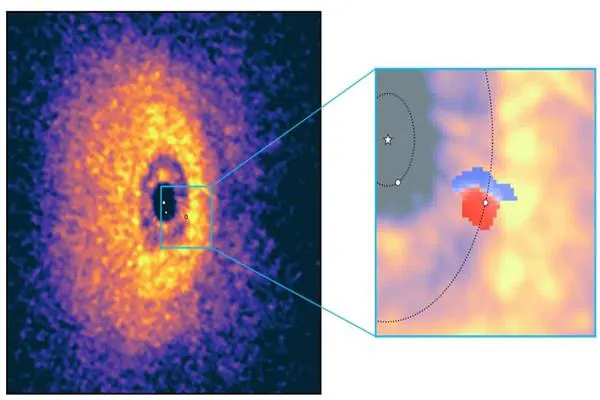
In a groundbreaking astronomical achievement, scientists have obtained the most detailed image to date of twin planets outside our solar system, showcasing their formation within a vast disk of gas and dust surrounding their parent star. This remarkable feat was accomplished using the Atacama Large Millimeter/submillimeter Array (ALMA) telescope, offering an unparalleled glimpse into the dynamic processes of planetary formation.
The stellar system, known as WISPIT 2, is located approximately 437 light-years away and features two small stars, estimated to be around 5.4 million years old, surrounded by a primordial disk rich in gas and dust. The planetary twins, WISPIT 2b and WISPIT 2c, are actively interacting with their environment, with the former, a gas giant with a mass five times that of Jupiter, carving a wide gap in the disk as it accumulates material to fuel its growth.
Miriam Benisty, a researcher at the Max Planck Institute in Germany, emphasized the significance of the findings, stating that the observations reveal both planets shaping their surroundings. Notably, around the first planet, researchers detected swirling gas patterns predicted by computer simulations but never before seen in real-time images.
The WISPIT 2 system is considered exceptional due to its unique configuration, allowing astronomers to simultaneously observe three crucial elements: the surrounding primordial disk, the planet itself, and clear evidence of the planet's accretion of material and direct interaction with the gas.
These groundbreaking results pave the way for the next generation of super telescopes, such as the Extremely Large Telescope (ELT) currently under construction in Chile, which will enable scientists to unravel the intricacies of planetary birth outside our galaxy with unprecedented precision.
The discovery provides new insights into the formation of celestial bodies, offering a fascinating glimpse into the early stages of planetary development. Further research and observations will continue to shed light on the mysteries of the universe, driving our understanding of the cosmos forward.
The findings have significant implications for the study of planetary formation and the exploration of the universe, marking a major milestone in the field of astronomy and setting the stage for future breakthroughs.
Key points
- Astronomers have captured an unprecedented image of twin planets forming around a young star using the ALMA telescope.
- The discovery provides new insights into the formation of celestial bodies, offering a glimpse into the early stages of planetary development.
- The findings pave the way for the next generation of super telescopes, such as the Extremely Large Telescope (ELT), to further explore the universe.