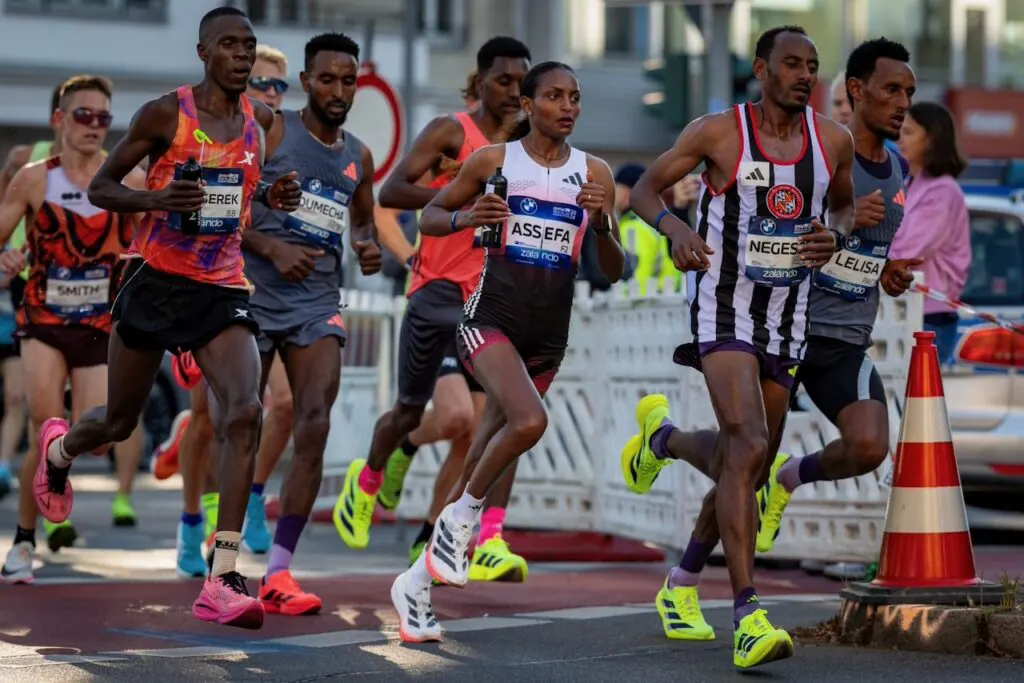
Ethiopia's Tigst Assefa came close to breaking the women's world record at the Berlin Marathon on Sunday, finishing with a time of 2:11:04. This achievement secured the third-best time in history, surpassing her personal best and course record of 2:11:53 set in 2023. Assefa had maintained a record pace for much of the race, accelerating in the final 10 kilometers. However, she struggled with an injury, visibly limping and collapsing after crossing the finish line.
The women's world record of 2:09:56 remains intact, held by Ruth Chepngetich. However, Chepngetich's record is clouded by a three-year doping ban she received in 2025. Assefa's late fade in the race meant she couldn't challenge the record. Despite this, Assefa secured an all-Ethiopian podium, with Bedatu Hirpa finishing second in 2:16:53 and Dera Dida coming third in 2:16:55.
In the men's race, Ethiopia's Guye Adola emerged victorious with a time of 2:02:50. This win adds to his 2021 Berlin Marathon victory. Adola's time was off the world record pace and outside the course record of 2:01:09 set by Eliud Kipchoge in 2022. Adola took the lead at the 30-kilometer mark and finished with a lead of almost 30 seconds.
Adola expressed his satisfaction with the race, stating that his strategy to hold back and observe the pacemakers worked well. He also expressed his affection for the Berlin Marathon, hinting at a possible return. The men's podium was also dominated by Ethiopians, with Gemechu Dida finishing second in 2:03:19 and Gabriel Geay of Tanzania coming third in 2:03:59.
The Berlin Marathon is considered one of the fastest major courses, having hosted 13 world record breaks. The event took place in September, and the temperate weather contributed to the fast times. The late withdrawal of men's world record holder Sabastian Sawe shifted attention to Assefa's attempt at the women's record.
Assefa, a three-time Berlin Marathon winner and Paris Olympics silver medalist, had vowed to run "better than my best" before the race. She started strongly, opening a 25-second lead by the 5km mark, which grew to a minute at 15km. Assefa maintained the record pace until around the 25km mark, before returning to the required speed.
Assefa's injury issues arose in the final stages, as she began limping and struggled to maintain her pace. Despite this, she finished with a remarkable time, securing her third-best finish in history. The Ethiopian was still on track for the record at 35km but ultimately fell short.
Key points
- Assefa finished third best in history with 2:11:04.
- Guye Adola won the men's race with 2:02:50.
- The women's world record remains with Ruth Chepngetich.