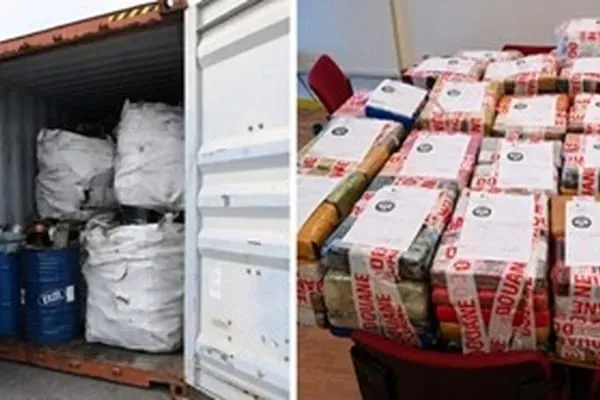
Private Legal Practitioner and New Patriotic Party member Kwasi Kwarteng has called for a more comprehensive approach to tackling Ghana's drug problem. He believes that arresting only the couriers will not be enough to solve the issue. Kwarteng's comments come as six persons stand trial for their connection to the seizure of 3.9 tonnes of cocaine in France. The accused, linked to the Ghana Revenue Authority's Customs Division, face charges of conspiracy to export narcotic drugs and unlawful exportation of narcotic drugs.
The six accused persons, including Francis Narh Amanor, owner of the logistics company that handled the export, and Frank Adu Boahen, the alleged owner of the goods, have been denied bail. Their counsel argued that the accused have been cooperative with investigators and have demonstrated their willingness to stand trial. The presiding judge adjourned proceedings to September 29 for a ruling on the bail application. The accused persons are Francis Narh Amanor, Frank Adu Boahen, Togbe Agbeti, Andrews Tetteh Amponsah, Daniel Laryea, and Helena Akua Dekyi.
According to the prosecution, Frank Adu-Boahen shared his login credentials to other accused persons, allowing them to access and scan containers. Despite detecting anomalies, the containers were allegedly given the greenlight without further examination. The prosecution also alleges that Adu-Boahen admitted to owning the four 40-foot containers and loading them at a warehouse in Tema. He reportedly told investigators that he shipped the containers with the help of Francis Narh Amanor.
The ICUMS system identified Fresna Commodities Ltd, led by Francis Narh Amanor, as the exporter, with Amanor's phone number listed as the exporter's contact. The same number was reportedly associated with F&F Logistics, the freight forwarder in the export of the containers. The prosecution alleges that Amanor and Adu-Boahen exported the four containers from Tema Port, containing approximately 3.9 tonnes of suspected narcotic substances.
The seizure of the 3.9 tonnes of cocaine in France has raised concerns about Ghana's role in the international drug trade. Kwarteng's comments highlight the need for a more comprehensive approach to tackling the problem. He emphasizes that arresting the kingpins behind the drug trade is crucial to solving the issue. The court case against the six accused persons is ongoing, with a ruling on their bail application expected on September 29.
The case has also raised questions about the security and integrity of Ghana's ports and logistics systems. The Ghana Revenue Authority's Customs Division has been linked to the accused persons, highlighting potential vulnerabilities in the system. The prosecution's allegations suggest that the accused persons exploited these vulnerabilities to export the narcotic substances.
The trial of the six accused persons will continue on September 29, with a ruling on their bail application expected. The case is seen as a significant test of Ghana's efforts to tackle the drug trade and ensure the security of its ports and logistics systems. Key issues, including the role of the kingpins and the vulnerabilities in the logistics system, will likely be scrutinized during the trial.
Key points
- Arresting only couriers will not solve Ghana's drug problem.
- Six persons are standing trial for their connection to the seizure of 3.9 tonnes of cocaine in France.
- The case highlights potential vulnerabilities in Ghana's ports and logistics systems.