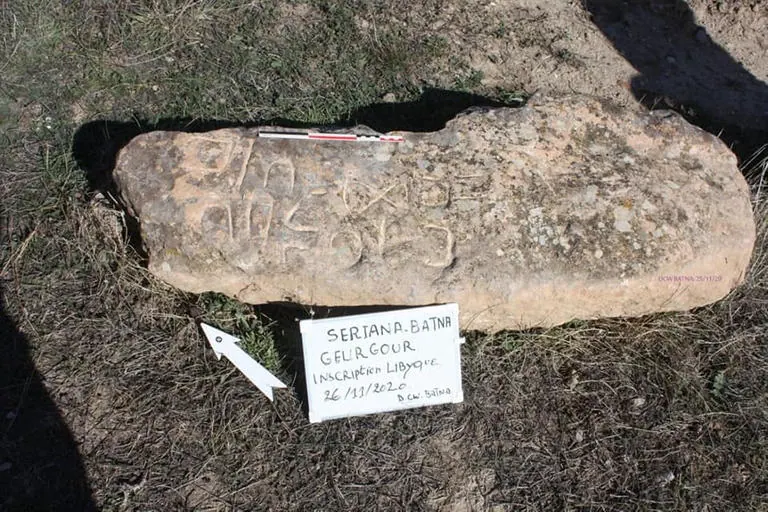
A significant archaeological find has been made in the Batna province of Algeria, where a team has discovered an ancient Libyan inscription at the "Qarqour" archaeological site in the Sryanah region. The inscription, dated to before the Roman era, was found on a limestone stone slab on November 25. According to Omar Kabour, Director of Culture and Arts for Batna province, this discovery highlights the potential for an important archaeological site from a civilization that predates the Roman presence in the area.
The inscription is only the second of its kind to be found in the same archaeological region, with the first discovered in 2018. Abdelkader Baitam, Head of the Antiquities Department at the Batna Culture and Arts Directorate, stated that the recently discovered stone slab is likely a tombstone. The inscription consists of three lines of ancient Libyan script, with the first line containing five characters, the second seven, and the third line being unreadable due to environmental and human-induced degradation.
The ancient Libyan language, also known as the Tifinagh, was prevalent in North Africa, specifically in present-day Libya, Tunisia, Algeria, and Morocco. This language had its own unique alphabet, which was used to write on cave walls and rocks. Initially, the script was written from top to bottom, then in all directions, before eventually evolving to be written from right to left.
The discovery of this inscription provides valuable insights into the history and culture of the region. The Batna province has become a focal point for archaeological research, with the Qarqour site potentially holding more secrets about the pre-Roman era. Further analysis and excavation of the site are expected to uncover more information about the civilization that once flourished there.
The significance of this find extends beyond the local community, as it contributes to a broader understanding of the ancient world. The Libyan script, in particular, is an important part of North African cultural heritage, and its study can provide a window into the lives of people who lived in the region thousands of years ago.
Conservation efforts are underway to preserve the inscription and the Qarqour site, ensuring that this piece of history is protected for future generations. The collaboration between local authorities and archaeological experts is crucial in this process, as they work together to unravel the secrets of the ancient Libyan civilization.
As research continues, the discovery of this ancient Libyan inscription serves as a reminder of the rich cultural heritage of the region. It highlights the importance of preserving and exploring archaeological sites, which can provide a deeper understanding of the complex history of North Africa.
Key points
- The discovery of an ancient Libyan inscription in Algeria's Batna province sheds light on the region's pre-Roman history.
- The inscription, found at the Qarqour archaeological site, is only the second of its kind to be discovered in the same region.
- The find contributes to a broader understanding of the ancient world and the cultural heritage of North Africa.