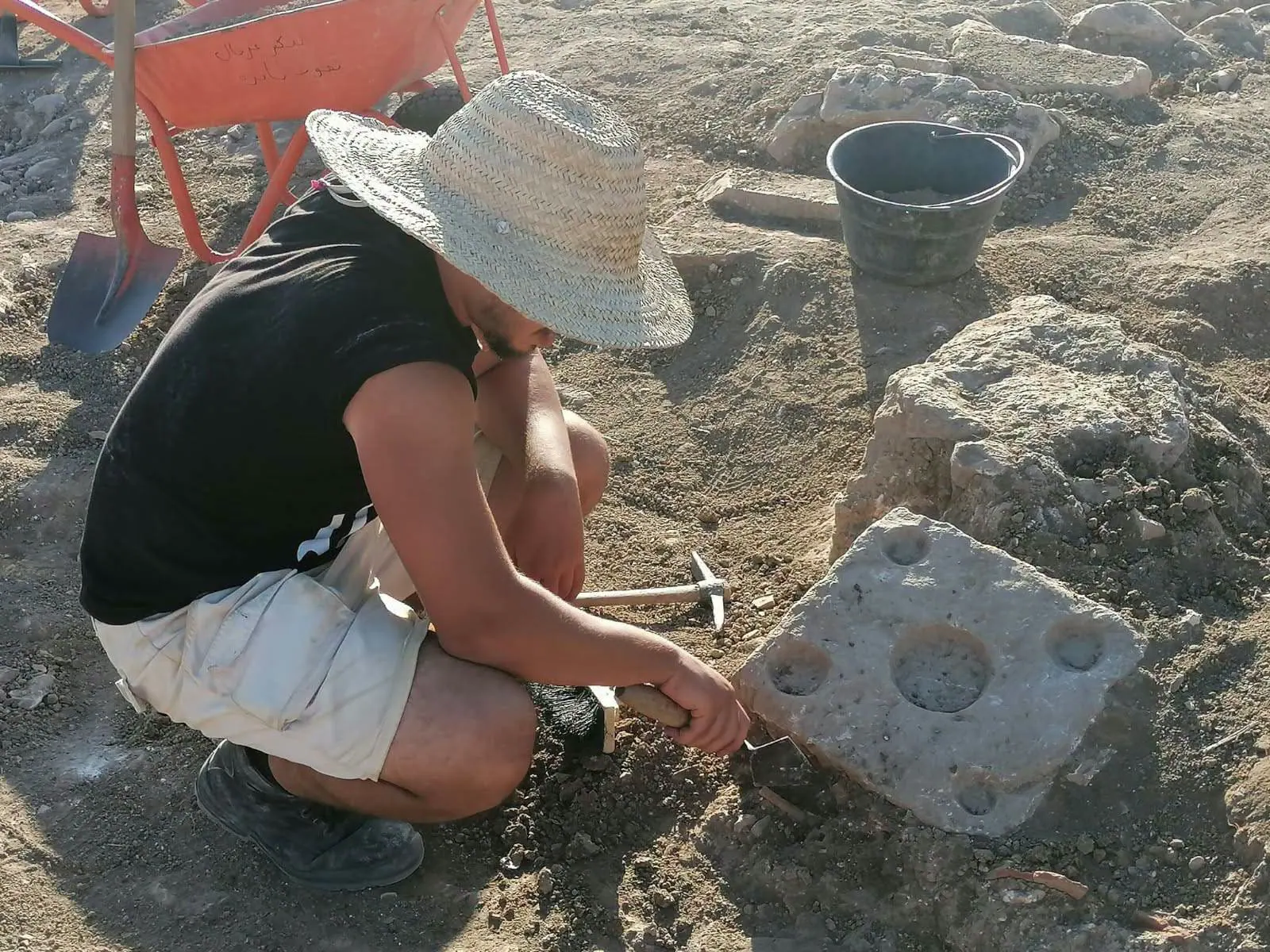
Archaeologists in Tunisia have made a significant discovery at the ancient site of Henchir El Matria, also known as Numluli, in the north of the country. The site, located near the town of Téboursouk in the Béja governorate, has yielded new evidence of the Vandal presence in the region. The Tunisian National Heritage Institute (INP) announced the discovery, which includes a 5th-century Christian basilica and several mosaic panels with inscriptions.
The excavation, conducted by the INP in collaboration with the University of Sassari, took place from September 6 to October 4. The team focused on two main areas of the ancient city, including the Roman-era Capitole, built in 170 AD. Excavations at the Capitole uncovered the paving of the public square, a fountain, columns, capitals, fragments of statues, and architectural ornaments.
The second area of excavation revealed a basilica built in the mid-5th century, which is considered a significant find. The basilica features tombs attributed to Christian personalities, various rooms and structures, as well as funerary jars and large vertical containers used for food storage. The site also yielded mosaic panels, which the INP considers crucial for reconstructing urban life in late Antiquity.
According to Moheddine Chaouali, director of historical research and archaeology at the INP, some of the 5th-century mosaics feature a Latin formula invoking the "salvation of kings." While the names of the rulers are not mentioned in the inscriptions, Chaouali believes this phrase alludes to the Vandal kings, providing valuable evidence of their presence in the region.
The discovery is significant, as archaeological evidence of Vandal rule has been scarce in the northwestern part of the country. Until now, most finds have been concentrated in Carthage, Haidra, and the Sousse region. The excavation at Numluli, a site that has been the subject of a joint Tunisian-Italian research program for several years, sheds new light on the history of the region.
The collaboration between the INP and the University of Sassari has been instrumental in uncovering the secrets of Numluli. The team, led by Chaouali and Alessandro Teatini, has made significant progress in understanding the transformation of African Roman cities during the imperial era, the Vandal kingdom, and late Christian Antiquity.
The findings at Numluli reinforce the site's importance as a key location for reconstructing the urban and religious history of the region. The discovery of the basilica and mosaic panels provides a rare glimpse into the realities of life in North Africa during the Vandal era, making it a significant contribution to the field of archaeology.
Key points
- The discovery of a 5th-century Christian basilica and mosaic panels with Latin inscriptions provides new evidence of the Vandal presence in northern Tunisia.
- The excavation, conducted by the Tunisian National Heritage Institute and the University of Sassari, sheds light on the transformation of African Roman cities during the imperial era, the Vandal kingdom, and late Christian Antiquity.
- The site of Numluli is a key location for reconstructing the urban and religious history of the region, providing a rare glimpse into life in North Africa during the Vandal era.