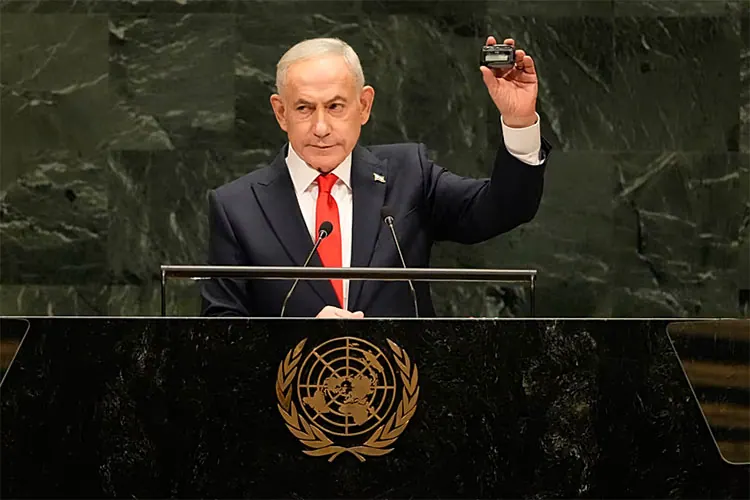
Israeli Prime Minister Benjamin Netanyahu has been a polarizing figure in recent years, with a track record of actions that have been widely criticized by the international community. His policies and decisions have had far-reaching consequences for the Palestinian people, and he has been accused of war crimes and crimes against humanity. Despite this, some Arab nations have surprisingly shown their support for him, sparking widespread criticism and outrage.
At a recent speech at the United Nations General Assembly in New York, Netanyahu's comments were met with a mixed reaction. While around 80 countries walked out in protest, some Arab nations, including the United Arab Emirates, Morocco, and Bahrain, remained seated and even applauded his remarks. This display of support has been seen as a betrayal by many, who argue that these nations should be standing in solidarity with the Palestinian people.
The UAE, Morocco, and Bahrain have been accused of having close ties with Israel, and their support for Netanyahu has been seen as a reflection of these relationships. Critics argue that these nations are prioritizing their own interests and agendas over the rights and well-being of the Palestinian people. This has sparked a heated debate about the role of Arab nations in promoting Palestinian rights and interests.
Many countries around the world have taken a strong stance against Netanyahu and his policies, with some even taking him to international court. Brazil, Spain, Chile, Ireland, Botswana, Slovenia, and Bolivia are among the countries that have publicly criticized Netanyahu and his actions. These nations have shown that it is possible to maintain diplomatic and economic ties with Israel while also speaking out against its policies.
The support shown by the UAE, Morocco, and Bahrain for Netanyahu has been seen as a stain on the reputation of Arab nations. Many argue that these countries are undermining the Arab world's credibility and legitimacy on the issue of Palestine. This has sparked a wider conversation about the role of Arab nations in promoting Palestinian rights and interests.
The incident has also raised questions about the influence of the Israeli lobby and the role of external forces in shaping the policies of Arab nations. Some have argued that the UAE, Morocco, and Bahrain are being influenced by external forces, including the Israeli lobby, which is shaping their policies and decisions.
The fallout from the incident is likely to be long-lasting, with many calling for Arab nations to re-examine their relationships with Israel and their stance on Palestinian rights. The incident has highlighted the need for Arab nations to prioritize Palestinian rights and interests, and to take a strong stance against Israeli aggression.
Key points
- Arab nations face criticism for supporting Israeli Prime Minister Benjamin Netanyahu at the UN.
- The UAE, Morocco, and Bahrain have been accused of having close ties with Israel, which has sparked criticism and outrage.
- Many countries around the world have taken a strong stance against Netanyahu and his policies, while Arab nations have been accused of undermining the Arab world's credibility on the issue of Palestine.