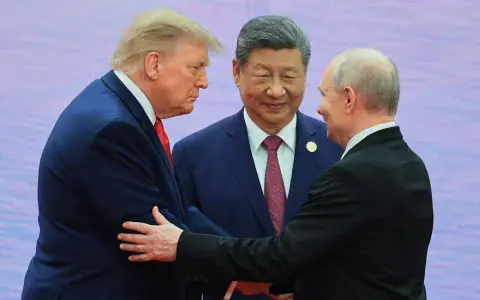
The Asia-Pacific Economic Cooperation (APEC) summit, held in Shenzhen, China, from November 18 to 19, 2026, brought together 21 member countries, representing over 60% of the world's GDP and nearly 2.7 billion people. The summit was overshadowed by a meeting between Chinese President Xi Jinping, Russian President Vladimir Putin, and US President Donald Trump, which lasted less than two hours. This encounter was seen as a display of the complex relationships and power dynamics between the three global powers.
The APEC organization was established in 1989, with 12 founding member countries, and has since grown to include 21 members. Its primary goal is to promote free trade and economic cooperation in the Asia-Pacific region. The organization is unique in that it brings together the three largest military powers: the US, China, and Russia, as well as other significant economies like Japan, Canada, and Australia. The APEC summit is an annual event that typically garners little attention from global media.
This year's summit was notable for being hosted by China, with President Xi Jinping seeking to showcase the country's technological advancements in a specially designed futuristic city, Shenzhen. The city is characterized by autonomous vehicles, drones, and robots, set against a backdrop of towering skyscrapers. The region is also significantly impacted by global events, such as the blockade of the Strait of Hormuz and rising energy costs.
Despite the significance of these issues, the meeting between the three leaders did not address the conflict in Ukraine or the war in Iran, which has been ongoing since the US initiated it. The final communiqué from the summit emphasized the importance of global peace but did not specifically mention the Ukraine conflict. The absence of discussion on these critical issues has raised questions about the priorities and agendas of the three major powers.
The meeting between Xi Jinping, Vladimir Putin, and Donald Trump was historic, marking the first time the three leaders had gathered together. Each leader sought to demonstrate their country's influence and power on the global stage. For Russia, under Vladimir Putin, the meeting served as an opportunity to reassert its position as a major military power, despite its ongoing conflict with Ukraine.
The US, under Donald Trump, is facing challenges, including a recent electoral setback and an ongoing conflict with Iran. The US remains a dominant military, economic, and technological power but faces increasing competition from China. The dynamics between these three nations will likely have significant implications for global politics and economies in the years to come.
The APEC summit and the meeting of the three leaders have sparked concerns and reactions worldwide, particularly in Europe, which views these developments as potentially leading to a new global division. However, not all regions share the same level of concern, with Africa, for instance, seeming less perturbed by the developments.
Key points
- The APEC summit highlighted the complex relationships between the world's major powers.
- The meeting between Xi Jinping, Vladimir Putin, and Donald Trump was seen as a display of power dynamics.
- The summit's focus and outcomes have significant implications for global politics and economies.