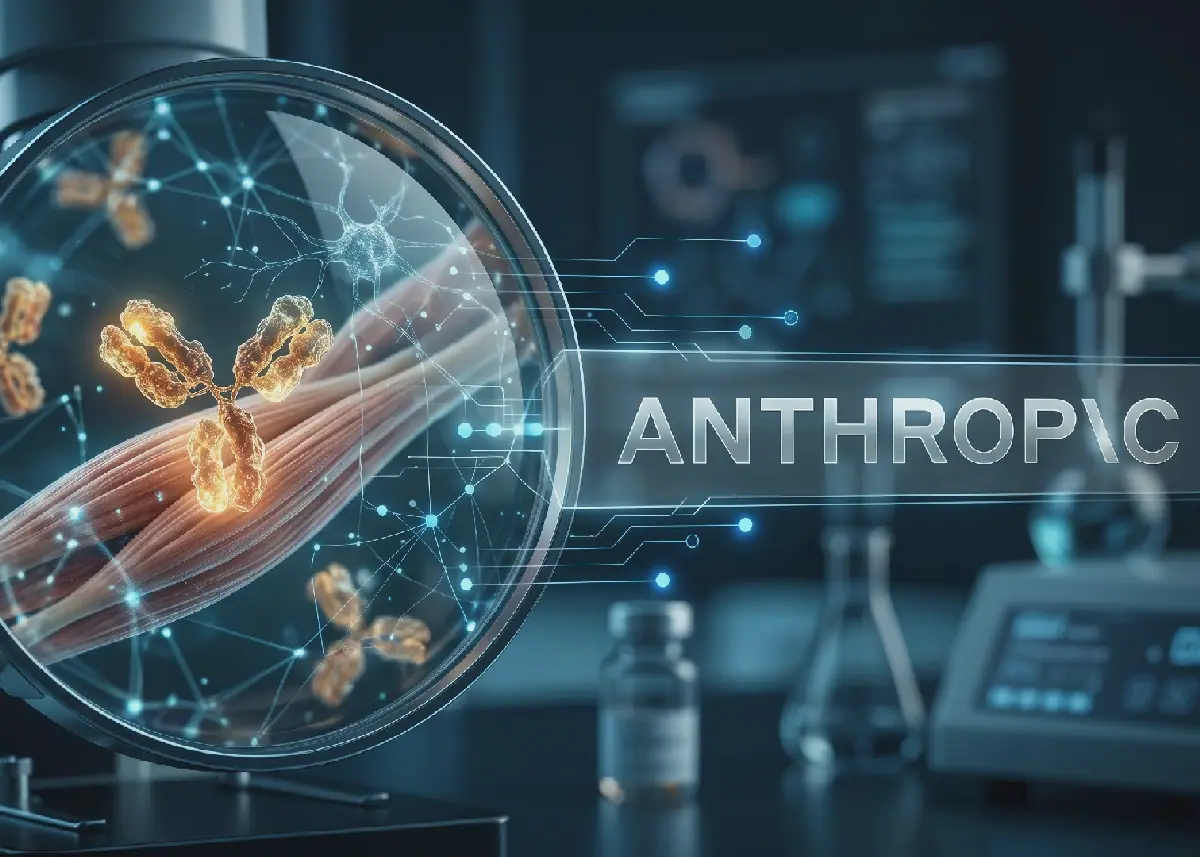
Anthropic, a leading AI company, has announced its foray into experimental medicine development. On October 27, 2026, the company revealed that it has initiated its own drug discovery programs, with a primary focus on rare childhood forms of muscular dystrophy. This move marks a significant shift for Anthropic, as it expands its capabilities from providing software to conducting in-house laboratory research.
The company's in-house effort is built on its acquisition of Mithril Medicine, a one-person company founded by Cody Tranbarger. Tranbarger utilized Anthropic's Claude AI to manage contracts, logistics, and experiments across 11 external labs, successfully developing a potential treatment for a rare muscular dystrophy in under 18 months. The treatment showed promising results in mice, with the animals displaying twice the muscle force and grip of those given a dummy solution.
Anthropic's experimental treatment targets a rare muscle-wasting condition affecting children from birth. The specially designed antibody has shown encouraging results in mice, but the science is still at a very early stage. The study, which was an early investigation rather than a tightly controlled experiment, has not undergone peer review. As such, it is too early to determine the treatment's safety or efficacy in humans.
In addition to its in-house efforts, Anthropic is collaborating with six life sciences organizations on various research projects. One of its partners, Generate Biomedicines, used Claude to design a CAR-T component that is approximately 70% shorter than the standard version. This innovative approach enabled immune cells to produce roughly 10 times as many cancer-spotting receptors in lab tests, bringing the company closer to treating solid tumors.
Another partner, BigHat Biosciences, tested around 1,010 variants of a cancer-targeting antibody fragment in just 10 weeks. The best versions demonstrated a binding affinity more than 10 times stronger than existing alternatives. Meanwhile, Bristol Myers Squibb is utilizing Claude to assess clinical trial plans, with the AI model producing an initial analysis from a single prompt that would have otherwise taken days to complete.
The use of AI in the drug development process has also streamlined paperwork and regulatory processes. At Enveda, reviewing 1,061 pages of manufacturing documents took less than three hours, down from over 25 hours. Claude also drafted a regulatory document in four hours, a task that would have taken approximately three months. These examples highlight the potential of AI to save time and resources in bringing new medicines to market.
Anthropic plans to scale up its biomedical research efforts substantially, with the goal of having a drug ready for human trials as early as late 2028. While the company acknowledges that its models still have limitations, the promising results from its in-house programs and partnerships suggest a bright future for AI-driven medicine development.
Key points
- Anthropic starts developing experimental medicines in-house, focusing on rare childhood muscular dystrophy.
- The company's treatment shows promise in mice, but human trials are still a long way off.
- Anthropic's AI technology also streamlines paperwork and regulatory processes in drug development.