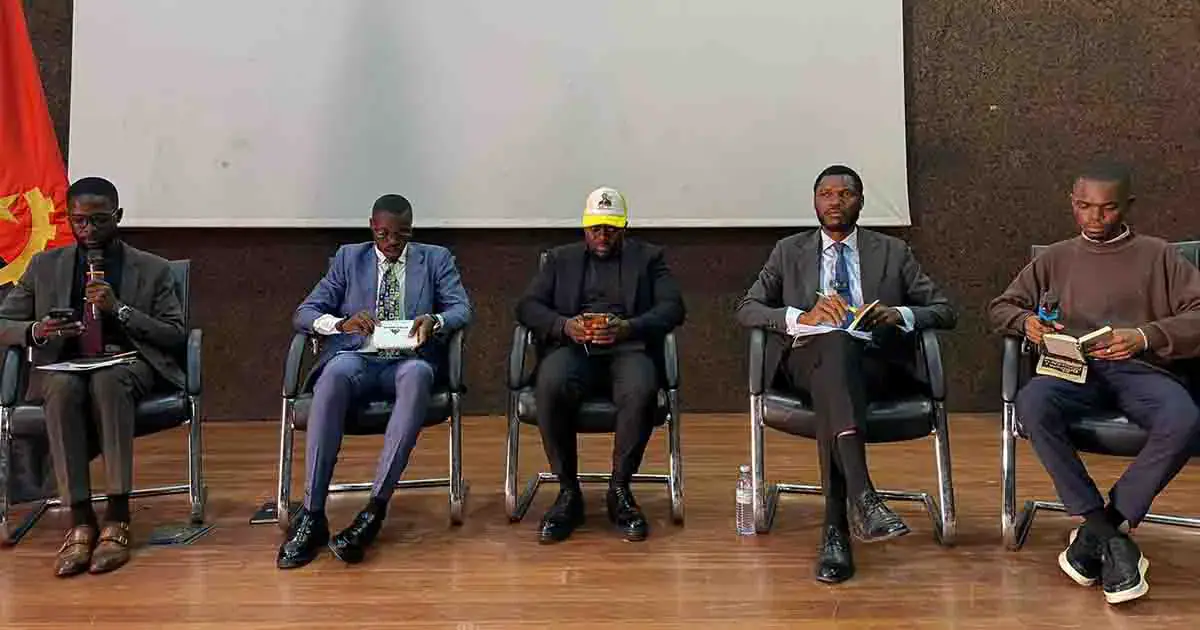
A roundtable discussion on political ideologies and their contribution to Angola's economic development, social justice, and democratic consolidation was held at the Huambo Provincial Library on November 5. The event, part of the JANGO CULTURAL initiative, brought together representatives from JMPLA, Partido Liberal, and JURA, along with political science expert Daniel Mayfuila. Osvaldo Temo moderated the debate, which saw participants present various perspectives on state organization, economic functioning, citizen participation, and democratic challenges.
Rafael Capapelo, representing JMPLA, defended socialist democracy as the MPLA's ideological orientation, highlighting principles of humanism, freedom, equality, and solidarity. He discussed the party's historical evolution, including its alignment with the Soviet bloc during the Cold War and its subsequent adoption of socialist democracy following international changes and the introduction of multipartyism in Angola. Capapelo emphasized that these principles guide the party's vision and governance strategy, linked to national development plans.
Alberto Cacumba, representing Partido Liberal, advocated for liberalism, emphasizing individual freedom, private property, entrepreneurial initiative, and free competition. He argued that the state should not act as both regulator and economic agent, criticizing its presence in public enterprises and advocating for a market economy with less state intervention. Cacumba also supported meritocracy as a means to ensure opportunities for citizens, regardless of party affiliation, and believed that prosperity should result from individual effort and capacity.
Florindo Soquila, representing JURA, identified UNITA as a center-right organization based on principles like social justice, equal opportunities, political pluralism, and competitive democracy. He defended popular sovereignty and democratic alternation, emphasizing citizens' role in choosing leaders through voting. Soquila also highlighted the importance of decentralization and local autonomy, associating local power with development, citizen participation, and improved governance.
The debate also touched on the role of the state in the economy, with Cacumba expressing concerns about state control and Soquila advocating for a more limited role. The participants' discussions reflected diverse perspectives on Angola's political and economic trajectory. The event demonstrated the complexity of ideological debates in Angola and the engagement of young people in shaping the country's future.
The roundtable discussion was part of a broader effort to promote critical thinking and civic engagement among young Angolans. By bringing together representatives from different political parties and a political science expert, the event facilitated a nuanced exploration of ideological perspectives and their implications for Angola's development. The discussions underscored the importance of ongoing dialogue and critical examination of political ideologies in the country.
The event concluded with a call for continued engagement and critical thinking about Angola's political and economic future. The participants' exchange of ideas highlighted the significance of youth involvement in shaping the country's trajectory and the need for ongoing discussions about the role of ideology in Angola's development. The debate demonstrated that young people are actively engaged in exploring and debating the country's future.
Key points
- The debate highlighted diverse perspectives on Angola's political and economic trajectory.
- The event demonstrated the complexity of ideological debates in Angola and the engagement of young people in shaping the country's future.
- The discussions underscored the importance of ongoing dialogue and critical examination of political ideologies in the country.