Angola's economy is undergoing a significant shift, with non-oil foreign investment increasing substantially. According to a study by the Centro de Estudos para o Desenvolvimento Económico e Social de África (CEDESA), investment direct foreign (IDE) in non-oil sectors rose from $353.5 million in 2024 to $959.4 million in 2025, a 170% increase. In the first half of 2026, IDE reached $971.8 million, surpassing the total for the entire previous year.
However, Rui Verde, an analyst and vice-president of CEDESA, cautions that this growth may not necessarily translate to new productive investments. The concept of IDE includes reinvestments of profits and financial operations between companies, which can inflate the numbers. Verde notes that an increase in IDE does not automatically mean an equivalent increase in real productive investment. For instance, a foreign company already operating in Angola may choose to retain its profits in the country, which would be counted as foreign direct investment.
The concentration of investment in mining, transportation, logistics, energy, and infrastructure associated with the Lobito Corridor is a concern for Verde. While these sectors are strategically important, their growth does not necessarily represent a deep diversification of Angola's economic structure. The country appears to be shifting from an oil-based economy to one focused on minerals such as copper, diamonds, gold, and rare earths.
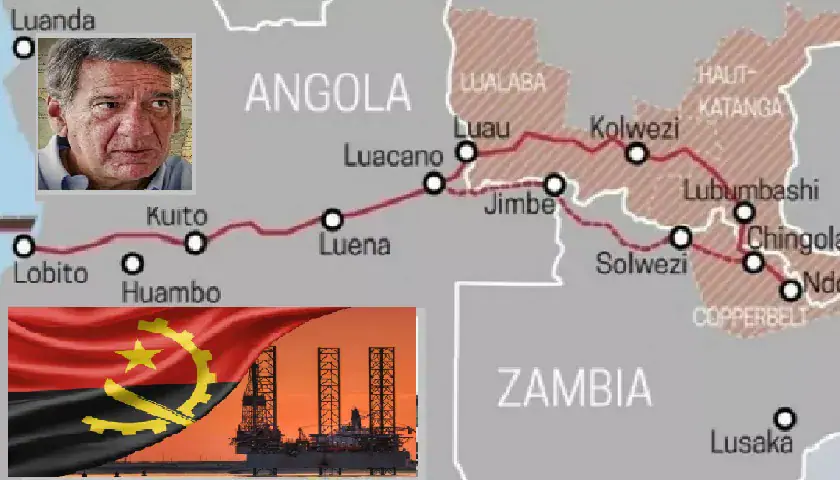
The Lobito Corridor, a railway project linking Angola's Atlantic port to the Democratic Republic of Congo, is a key driver of this shift. The project, backed by the US, European Union, and international financial institutions, aims to facilitate the transportation of minerals from the region. Verde suggests that part of the investment flows may be linked to anticipated future returns from regional logistics and the value chain of critical minerals.
Despite some positive developments in sectors like agriculture, transportation, and construction, Verde warns that this may not signify a structural transformation. The growth of non-oil activities and increased investment in new sectors are notable, but the country's historical dependence on raw materials remains a challenge.
Verde emphasizes that it is premature to conclude that Angola has overcome its dependence on raw materials. To confirm a genuine structural change, it is essential to monitor economic indicators beyond 2026 and assess whether high levels of non-oil investment and export growth are sustained. If investment flows decline to pre-2025 levels and remain concentrated in mining and logistics, the 2025 and 2026 results may represent a specific investment cycle linked to the Lobito Corridor and competition for critical minerals.
The study's findings highlight the need for careful analysis of Angola's economic diversification efforts. While there are positive trends, it is crucial to consider the nature and sustainability of these developments. The country's economic trajectory will depend on its ability to balance growth in strategic sectors with broader structural transformation and reduced dependence on raw materials.
Key points
- Angola's non-oil foreign investment surged by 170% in 2025, driven by mining and infrastructure projects.
- The concentration of investment in a few sectors raises concerns about the depth of economic diversification.
- Sustained growth in non-oil sectors and exports will be crucial to confirming a structural transformation in Angola's economy.
Reporting sources
- CICLO PETROLÍFERO PERDE TERRENO PARA O DOS MINERAIS · jornalf8.net