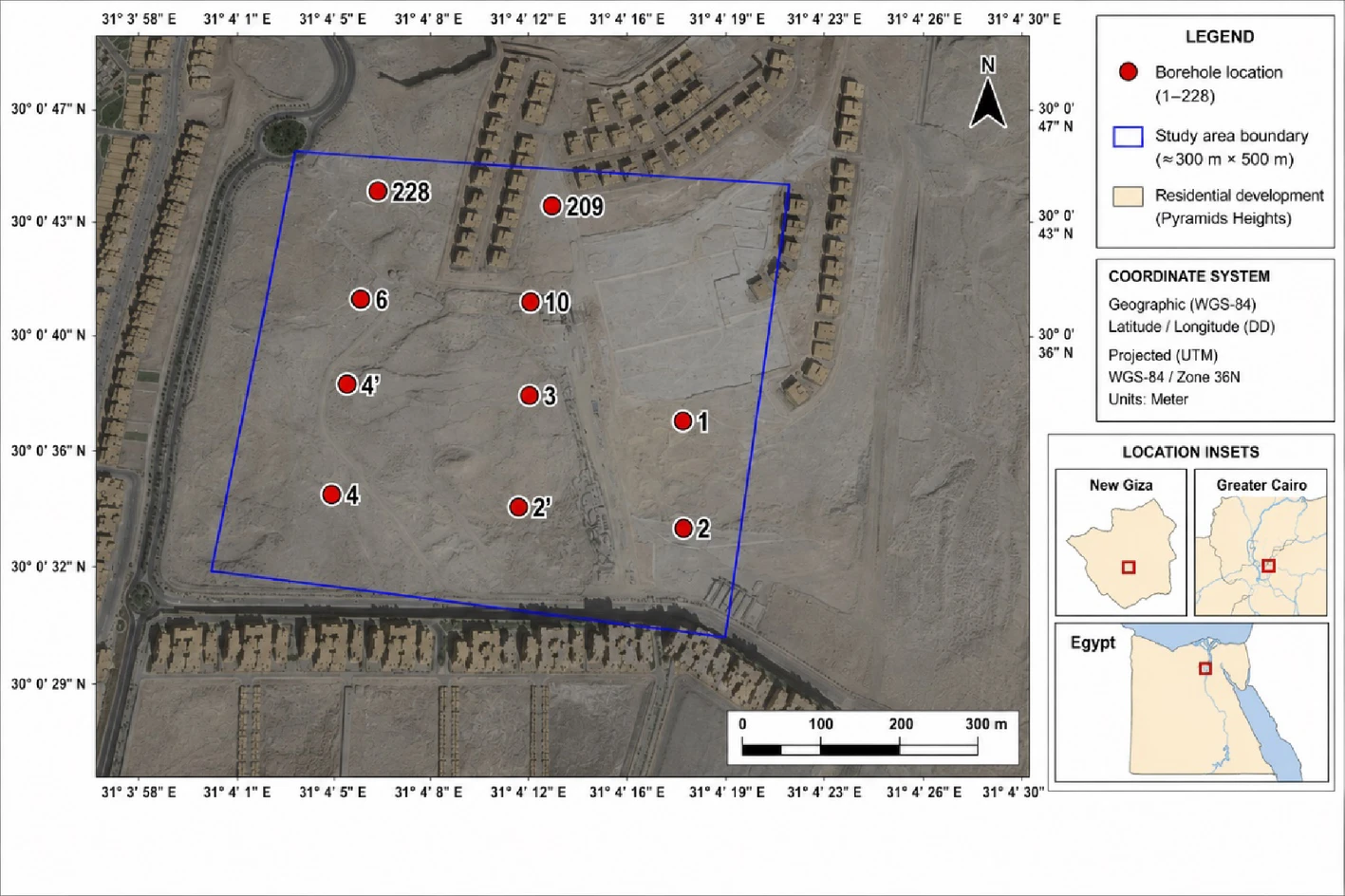
A recent study published in Discover Geoscience has shed light on the geological composition of New Giza, a rapidly expanding urban area in western Cairo. The research, led by geophysics researcher El-Hussein M. Ali from Ain Shams University's Faculty of Science, examined the limestone layers formed in an ancient sea around 90 million years ago. These layers now support the weight of New Giza's growing urban landscape. The study aimed to link the area's geological history to practical engineering questions, specifically how much weight different rock layers can safely carry.
The researchers studied carbonate rocks from the Abu Roash Formation, focusing on their behavior under pressure at Pyramids Heights, about 16 kilometers west of Cairo. A network of 228 boreholes across the site was used, and detailed laboratory testing was conducted on 12 selected samples. The samples were compressed until they failed, allowing the researchers to measure their strength and response to loading. The results showed significant differences in rock strength, ranging from 4.93 to 19.69 megapascals, and the amount of pressure the rock could safely support, varying from about 1.25 to 4.99 megapascals.
The study revealed that some rock layers could safely carry substantially heavier loads than others. The Acteonella Series emerged as the strongest layer, with a safe bearing capacity of around 4.8 to 5.0 megapascals, making it a reliable foundation layer. In contrast, the Flint Series, containing chalky limestone, marl, and porous material, performed poorly, with values as low as 1.2 megapascals. These findings are crucial for engineers and planners, as ground that appears solid at the surface may conceal cavities, weak pockets, or fractured rock.
Faults and fractures in the rock layers add another layer of complexity. Fractures can provide pathways for water, allowing it to dissolve carbonate rocks and create voids underground. For the weakest locations, the researchers recommend measures such as pressure grouting, which fills underground cavities, or micropiles, which transfer a building's weight through weak material to stronger rock below. They also suggest incorporating fault zones into municipal geographic information system (GIS) maps, enabling planners to identify potentially challenging construction sites before permits are issued.
The approach could extend beyond Pyramids Heights, as similar carbonate formations occur beneath other Egyptian urban expansion areas, including 6th of October City, Sheikh Zayed City, and New Cairo. This geological mapping could help planners develop broader foundation-suitability maps. However, the researchers caution that their detailed laboratory analysis involved only 12 samples and focused on intact pieces of rock, whereas actual underground rock masses contain fractures, joints, and cavities that can make them weaker.
The study calls for additional field testing and broader sampling before its measurements are applied to individual building designs. According to Ali and his co-authors, the differences in rock strength reflect how the rocks were originally deposited, how some layers were later hardened while others were dissolved by water, and how faults and fractures altered the ground over millions of years. The rocks retain a geological "memory" that can help engineers anticipate where foundations may perform well—and where problems may be hidden underground.
The findings of this study have significant implications for future construction in New Giza and other urban areas with similar geological compositions. By taking into account the varying strength and durability of the rock layers, engineers and planners can design safer and more efficient foundations, reducing the risk of structural failures and ensuring the long-term stability of buildings. The study's results can also inform urban planning decisions, enabling more effective use of land and resources.
Key points
- The study highlights the importance of geological mapping in urban planning and construction.
- The Acteonella Series is identified as a reliable foundation layer, while the Flint Series is found to be weaker.
- The researchers recommend additional field testing and broader sampling to validate the findings.