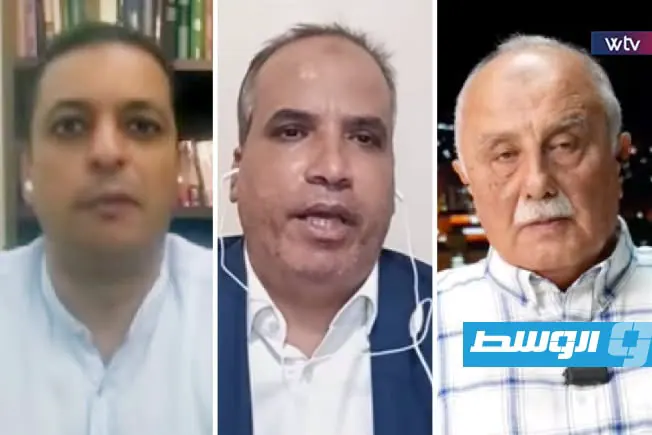
Libyan political analysts have warned of the consequences of continued stagnation in the country's political process. They suggest that if the 4+4 committee's outputs are not adopted, the UN mission may need to explore alternative paths to complete the implementation of the roadmap and hold elections. The analysts made these comments during a discussion on the "Middle News" program broadcast on Al-Wasat TV.
The 4+4 committee's outputs focus on completing the constitutional basis and electoral laws and reconstituting the National High Commission for Elections. The UN mission will oversee the subsequent political stages. According to analyst Wasam Abdelkaber, the committee's outputs can be activated through a national mechanism with broad representation if the House of Representatives and the High Council of State fail to adopt them within the specified timeframe.
Abdelkaber noted that the deadline for adopting the outputs is the end of September, leaving the UN mission with time to maneuver. He mentioned that the mission has more than one option before referring the file to the Security Council. The House of Representatives has already approved the outputs, but the High Council of State's position remains unclear, with disagreements over the quorum and procedures.
Analyst Meeskab Al-Qaid suggested that the UN mission may need to expand the political dialogue to include parties other than the House of Representatives and the High Council of State. He proposed that the mission could rely on the provisions of the political agreement to broaden participation, including parties, political forces, and civil society components.
Al-Qaid recommended establishing a clear mechanism for forming a unified government, free from political pressures and negotiations. He suggested that the outputs of the political dialogue should be transformed into a government program, with candidates for the prime minister's position presenting specific programs and timelines.
Analyst Belqasim Buiyser emphasized the need for the next government to be limited and temporary in its mandate, focusing on preparing the conditions for elections and completing the electoral process. He warned against the new government becoming a long-term authority, as seen in previous governments.
The analysts also discussed the international and regional efforts to push the Libyan political process forward. Abdelkaber mentioned the recent Egyptian-American contacts regarding Libya, which could influence the parties to overcome obstacles and move towards unifying institutions and holding elections.
Key points
- The UN mission may need to expand the political dialogue to include more parties if the 4+4 committee's outputs are not adopted.
- Analysts stress the need for a unified government and a clear mechanism for its formation.
- The international community is closely watching the developments in Libya, with Egypt and the US engaged in contacts to push the political process forward.