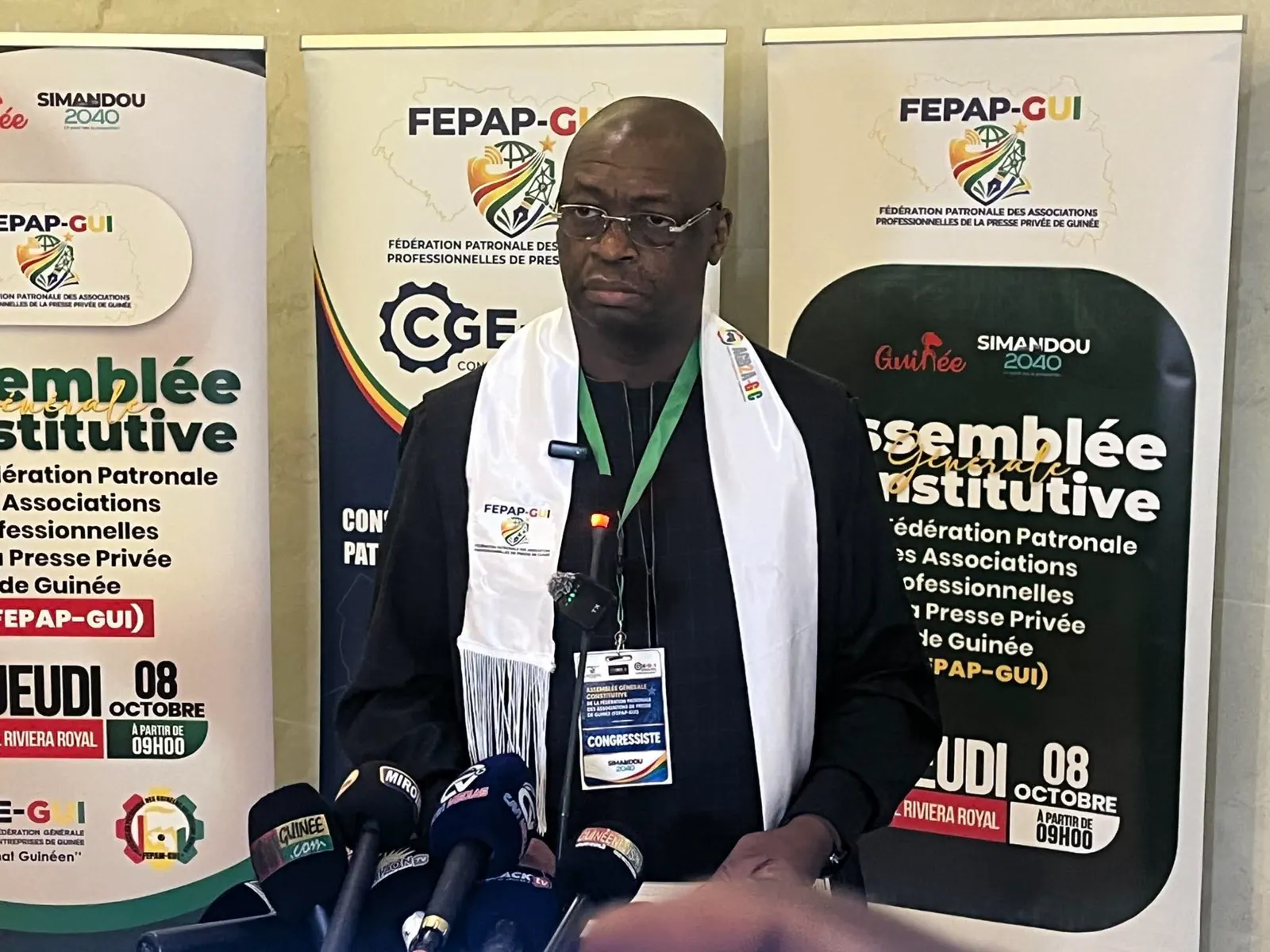
On October 8, 2026, Amadou Tham Camara was elected president of the Fédération patronale des associations professionnelles de presse de Guinée (FEPAP-GUI), a new organization aimed at promoting and defending the interests of Guinea's private press sector. The election took place during a constitutive general assembly held in Conakry, where Camara outlined his vision for the sector. He emphasized the need for a strong and viable press sector, highlighting the importance of economic stability for press freedom.
Camara's election was followed by the validation of the organization's texts, which were approved unanimously by the participants. He acknowledged the support of various stakeholders, including the Confédération générale des entreprises de Guinée (CGGUI), the Haute Autorité de la Communication, the Inspection générale du Travail, and the ministry in charge of Communication. Camara stressed that the creation of FEPAP-GUI marks a significant step towards uniting the sector and defending its collective interests.
The new president identified the economic viability of press enterprises as a key priority for his mandate. He argued that press freedom cannot be sustained without economically viable enterprises that are also juridically protected and professionally solid. To achieve this, FEPAP-GUI plans to advocate for adapted fiscal policies, increased transparency in the advertising market, and objective criteria for allocating institutional advertising.
Camara also announced plans to facilitate access to financing and markets for media outlets, protect journalists' content, and engage in discussions with major digital platforms that use Guinean media productions. The transformation of digital media and the responsible use of artificial intelligence are also on the agenda. Furthermore, he confirmed that the signing of a collective convention for the press sector is imminent, aiming to strike a better balance between the economic situation of enterprises and working conditions for journalists and other sector employees.
To address the challenges facing the sector, Camara announced the establishment of an economic observatory for media outlets. This tool will collect data on the sector, monitor the advertising market, analyze employment, and publish regular reports on the state of the media in Guinea. FEPAP-GUI also aims to encourage the mutualization of certain services, develop common platforms, and explore new funding sources.
The new president emphasized the need to address the disparities between media outlets in Conakry and those in the country's interior. He announced plans to establish regional focal points and prioritize training, youth employment, women's promotion, and capacity building for media managers. Camara also promised transparent governance, collegiality, and accountability within FEPAP-GUI, including the establishment of an independent audit commission.
Camara concluded by emphasizing that his mandate will focus on delivering tangible results rather than mere rhetoric. He proposed a new framework for collaboration with public authorities, aiming to build a partnership that supports the professionalization of the press sector. As president of FEPAP-GUI, Camara aims to create a unified voice for Guinea's press enterprises, capable of defending their interests while promoting sectoral growth.
Key points
- Amadou Tham Camara elected president of FEPAP-GUI
- FEPAP-GUI aims to promote economically viable press enterprises
- New president prioritizes sectoral unity and professionalization