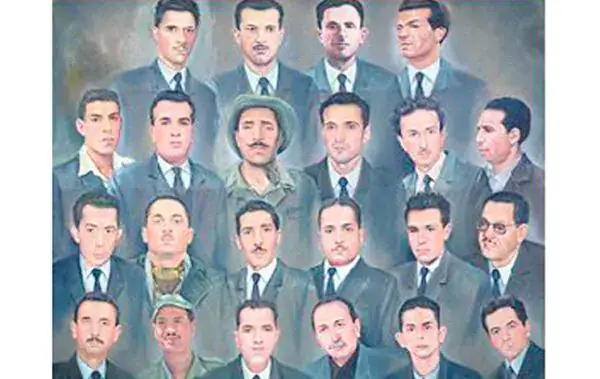
The Groupe des 22, a gathering of Algerian nationalists, held a pivotal meeting on June 25, 1954, in El-Madania, Algeria. The attendees, all members of the Organisation Spéciale (OS), laid the groundwork for the Algerian Revolution. This secret meeting marked a turning point in the country's struggle for independence from French colonial rule. The group, which included prominent figures such as Ahmed Ben Bella, Hocine Aït Ahmed, and Mohamed Boudiaf, aimed to overcome internal divisions and initiate an armed insurrection.
For 132 years, Algeria was colonized by France, resulting in the systematic expropriation of land and social and economic marginalization of the Algerian people. The early 20th century saw widespread famines, epidemics, and poverty, which became the daily reality for most inhabitants. The colonial power institutionalized injustice and inequality, fueling the desire for liberty and anti-colonial resistance among Algerians. This led to the emergence of nationalism in the 1920s, led by associations such as the Association of Muslim Ulemas of Ibn Badis.
The creation of the Parti du Peuple Algérien (PPA) in 1937 by Messali Hadj marked a new stage in the dissemination of independence ideas. However, the party was dissolved in 1939, and its leaders, including Messali Hadj, were sentenced to heavy penalties. Despite this, the PPA continued its activities in secret, strengthening the determination of militants to fight for Algerian independence. The repression of the May 8, 1945, demonstrations radicalized Algerian nationalists, leading to the formation of new parties, including the Union Démocratique du Manifeste Algérien (UDMA) and the Mouvement pour le Triomphe des Libertés Démocratiques (MTLD).
In 1947, the Organisation Spéciale (OS) was established, with young nationalist militants, including Ahmed Ben Bella, Hocine Aït Ahmed, and Mohamed Boudiaf. The OS was tasked with preparing an armed struggle against French colonization. The turbulent relationship between the PPA and MTLD led to a conflict between Messali and the MTLD central committee, which favored the creation of a National Algerian Congress. This conflict was overcome with the creation of the Comité Révolutionnaire pour l'Unité et l'Action (CRUA) in March 1954.
The CRUA, which aimed for armed action, quickly became an autonomous force. In June, it organized the Groupe des 22, which included prominent figures such as Othmane Belouizdad, Mostefa Ben Boulaïd, and Larbi Ben M'Hidi. The meeting, held at the home of militant Lyès Derriche, laid the foundations for a dynamic that would lead to the Algerian Revolution. The Groupe des 22 recommended the creation of five zones directed by CRUA coordinators, including the Aurès-Nememcha zone, led by Ben Boulaïd.
The CRUA, now known as the Front de Libération Nationale (FLN), created its armed wing, the Armée de Libération Nationale (ALN). The date of November 1, 1954, was chosen as the starting point for the Revolution. A proclamation, signed by the General Secretariat, was written and distributed in Algeria and Egypt, marking the beginning of the Algerian Revolution.
The Groupe des 22's meeting marked a decisive moment in Algerian history, as it brought together nationalist leaders who would lead the country's fight for independence. The FLN's creation and the launch of the Revolution on November 1, 1954, paved the way for a long and bloody conflict that would ultimately lead to Algeria's independence from France in 1962.
Key points
- The Groupe des 22's meeting on June 25, 1954, laid the groundwork for the Algerian Revolution and the creation of the Front de Libération Nationale (FLN).
- The CRUA, established in March 1954, played a crucial role in organizing the Groupe des 22 and planning the armed insurrection against French colonial rule.
- The Algerian Revolution, which began on November 1, 1954, marked a turning point in the country's struggle for independence from French colonial rule.