The Accra High Court, presided over by Justice Francis Apangabuno Achibonga, has dismissed an application by the defense to expunge portions of the prosecution's written submissions in the case of the Republic v. Kwabena Adu-Boahene & 2 Others. The defense team, led by Hon. Samuel Atta Akyea, had alleged that the state's written address contained fabrications and attributions unsupported by actual witness testimonies on record.
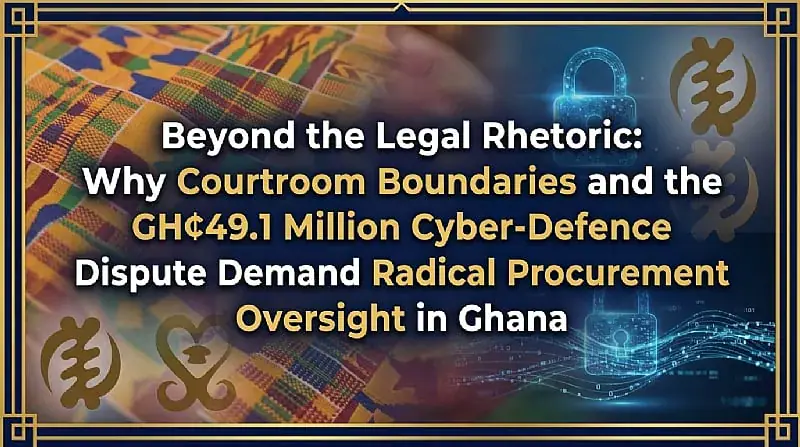
The case involves the alleged diversion of GH¢49.1 million earmarked for procuring a US$7 million state-of-the-art cyber-defence system designed to protect Ghana's critical digital infrastructure. The former Director-General of the National Signals Bureau (NSB), Kwabena Adu-Boahene, alongside his wife Angela Adjei Boateng and a third accused, are standing trial.
The defense argued that the state's closing address crossed the line from permissible inference into outright fabrication, invoking landmark Supreme Court precedents to support their claim. They cited cases such as Francis Asuming and 640 Others v. Divestiture Implementation Committee and Republic v. Court of Appeal; Ex parte Tsatsu Tsikata [2005-2006] SCGLR 612.
Justice Achibonga established that it is not the duty of the court to inquire into whether or not a written submission filed by Counsel is a true reflection of the evidence led. The judge emphasized that written addresses are merely persuasive guides—not evidence—and highlighted the structural vulnerabilities of multi-million cedi state contracts.
The prosecution successfully argued that the court lacked jurisdiction to physically censor a written brief simply because its accuracy was disputed. The judge agreed that in an adversarial system, the judge does not edit counsel’s briefs, and a written submission holds zero evidential value.
The trial judge's duty is to ignore inaccurate summaries and base their decision solely on the official transcripts and admitted exhibits. The High Court has set November 5, 2026, to rule on the substantive "submission of no case to answer".
To protect public integrity and reinforce state administration, stakeholders have recommended elevating standards of pleadings, strengthening national security procurement oversight, and focusing media coverage on substantive law. The judiciary must remain fully insulated from political debates and media pressure, assessing the upcoming November 5 ruling strictly on whether the state has met its burden of proof.
Key points
- The Accra High Court upholds limits of judicial intervention in a high-profile financial crime trial.
- The case involves the alleged diversion of GH¢49.1 million earmarked for a cyber-defence system.
- The court's decision highlights the structural vulnerabilities of multi-million cedi state contracts.