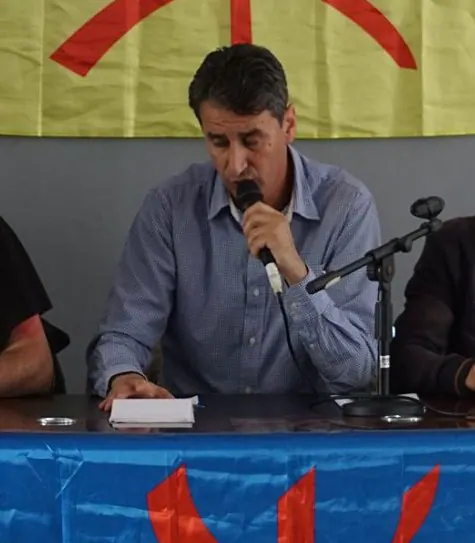
Mustapha Hadni, national coordinator of the Party for Laïcité and Democracy (PLD), recently gave a conference lecture in M'chedallah, addressing the country's national political situation, its current state, and future prospects. The event, organized by the Collective of M'chedallah Students, paid tribute to Dr. Kamel Eddine Fekhar. Hadni discussed the origins of Algeria's current political system, dating back to the 1930s under Messali L'hadj, which led to an arabo-islamic orientation and a 1949 crisis between arabo-islamist and Berberist movements.
According to Hadni, these two movements represent fundamentally different visions for an independent Algeria. The 1956 Soummam Congress significantly influenced the FLN's historical project, prioritizing civilian over military leadership. However, the arabo-islamist movement countered these resolutions, resulting in the physical liquidation of key leaders like Abane Ramadane by the Oudjda group. This led to the militarization of the regime and forced opposition parties to operate clandestinely.
The PLD coordinator stated that Islamists thwarted the political momentum following the October 1988 popular movement. This movement had sparked a citizen-led dynamic that the Islamic movement unfortunately undermined. Although terrorism was eventually controlled by patriotic resistance, the arrival of Abdelaziz Bouteflika to power further eroded civil society by promoting corruption during his 20-year rule.
Fortunately, democratic currents persisted until the February 22 uprising, sparked by Bouteflika's attempt to extend his rule with a fifth term. Hadni argued that it is now crucial to establish a state of law and dismantle the existing system, allowing civil society and the Algerian people to determine their future. Political parties must engage in a democratic transition, advocating for a republican and democratic shift.
In his concluding remarks, Hadni called for the dissolution of elected political institutions and the UGTA. He emphasized the need to dismantle the "rentier" apparatus and ensure the military accompanies this transition. Additionally, he proposed establishing a mechanism to monitor party financing.
The conference, attended by local students and community members, demonstrated a clear desire for democratic reform and a re-evaluation of Algeria's current political landscape. As the country navigates this critical juncture, voices like Hadni's contribute to an ongoing national conversation about its future direction.
Moving forward, the PLD and other democratic forces will likely continue to advocate for substantial reforms. The dissolution of the UGTA and transition to a more democratic state remain key demands in their push for meaningful change.
Key points
- Mustapha Hadni calls for dissolution of UGTA and transition to democratic state
- The current Algerian political system has roots in the 1930s under Messali L'hadj
- The Soummam Congress of 1956 significantly influenced the FLN's historical project