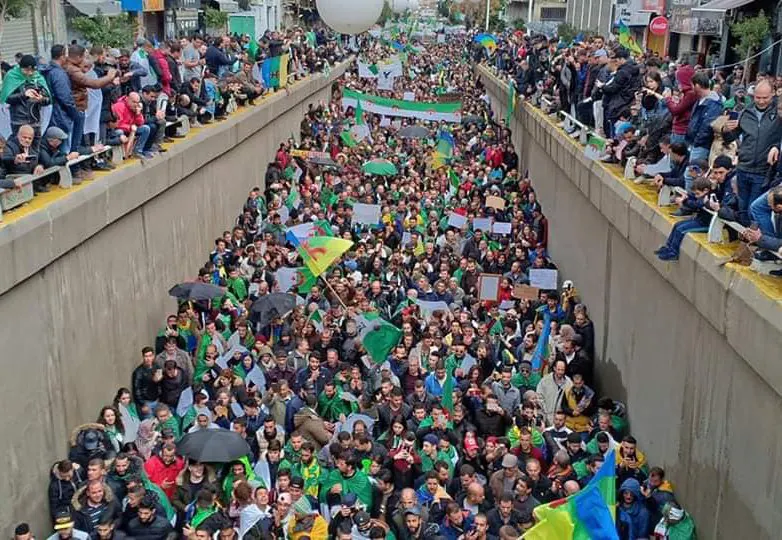
The Algerian political landscape is witnessing a surge in reactions from various stakeholders following the eighth consecutive Friday of protests. The protests, which began in February, have been marked by widespread demonstrations against the government, with protesters demanding a change in the country's leadership and system. In response to the escalating situation, the government has taken several steps, including the activation of Article 102 of the Constitution, which allows for the president to appoint a temporary head of state. Abdelkader Bensalah has been appointed as the interim head of state for a period of 90 days.
Notable Algerian lawyer and human rights activist, Mustapha Bouchachi, has expressed his reservations about the government's recent decisions. In a video statement, Bouchachi argued that the measures taken by the government do not align with the aspirations of the Algerian people, who have been demanding a more profound change in the country's system. He emphasized that the protesters are not just seeking the departure of former President Bouteflika but a complete overhaul of the existing system. Bouchachi also questioned the legitimacy of the individuals appointed to oversee the transition period, including Bensalah, Nourredine Bedoui, and Belaiz.
Bouchachi's concerns were echoed by another prominent lawyer, Mokrane Aït Larbi, who called on the Algerian army to side with the protesters. Speaking at a meeting in Kherrata, Béjaïa, Aït Larbi emphasized that the army's primary role is to defend the country's borders and protect its citizens, not to shield the corrupt officials. He urged the army to listen to the people's demands and ensure a peaceful transfer of power. Aït Larbi also stressed the need for the protesters to continue their mobilization, citing the need to bring the corrupt officials to justice.
The protesters' demands have been met with skepticism by some officials, including a general in the Algerian army, who described the demands as "unrealistic." Bouchachi responded to these comments, arguing that the protesters' demands are legitimate and not unrealistic. He emphasized that the transition period should be led by individuals who are not associated with the existing corrupt system. Bouchachi also expressed his disappointment with the army's recent statements, which he believes are not in line with the protesters' aspirations.
The Algerian government has announced plans to hold a presidential election on July 4. However, Bouchachi questioned the legitimacy of this election, given the current circumstances. He argued that it is not possible to talk about a free and fair election when the entire nation is protesting against the existing system. Bouchachi also expressed concerns about the government's intentions, suggesting that they may be trying to maintain the status quo.
Aït Larbi, meanwhile, called on the protesters to remain vigilant and continue their mobilization. He emphasized that the struggle for change will not be easy and may take time, but it is essential to pursue a peaceful transition. Aït Larbi also urged the protesters to focus on recovering the National Liberation Front (FLN), which he believes has been hijacked by the corrupt officials.
As the situation in Algeria continues to unfold, the international community is watching closely. The country's transition to a more democratic system is being closely monitored, with many hoping that the protesters' demands will be met. The role of the Algerian army in the transition period will be crucial, and it remains to be seen whether they will side with the protesters or maintain their support for the existing government.
Key points
- The Algerian government has activated Article 102 of the Constitution, appointing Abdelkader Bensalah as interim head of state for 90 days.
- Notable lawyers and human rights activists, including Mustapha Bouchachi and Mokrane Aït Larbi, have expressed concerns about the government's recent decisions and called for a peaceful transition.
- The Algerian army's role in the transition period will be crucial in determining the country's future.