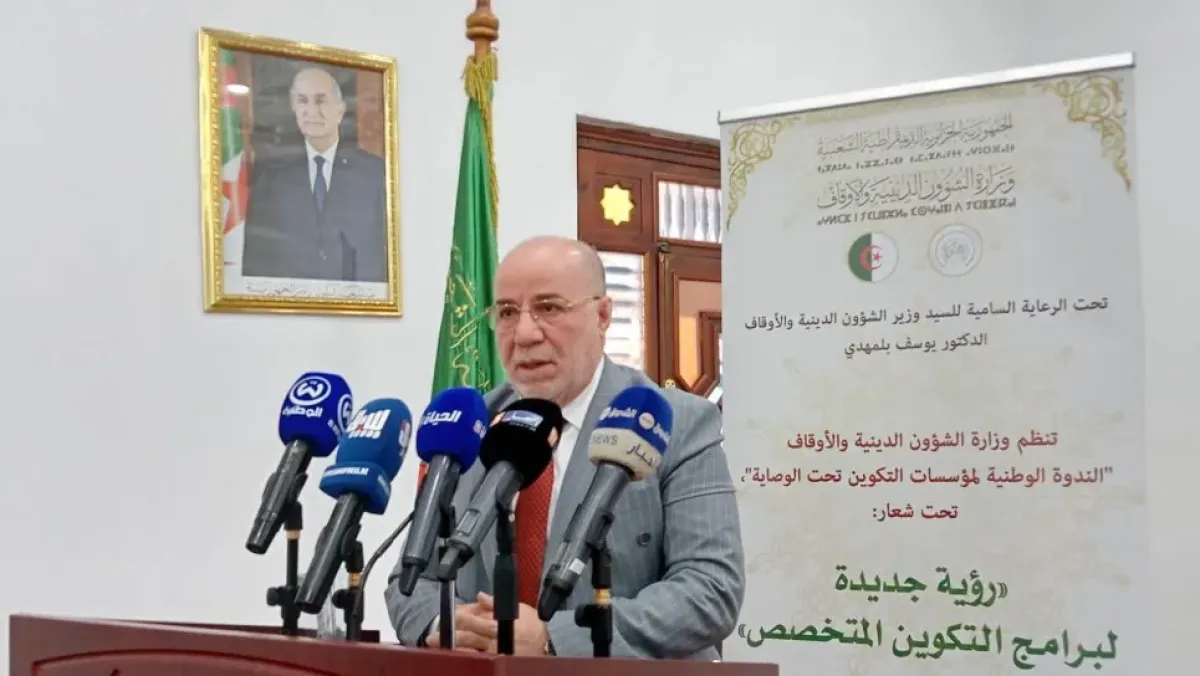
On September 22, 2026, Algerian Minister of Religious Affairs and Endowments, Youssef Belmehdi, oversaw the opening of the National Symposium for training institutions under his supervision. The event, themed "A New Vision for Specialized Training Programs," took place at the National School for Training and Improving the Level of Religious Administration and Endowments "Imam Sidi Abd al-Rahman al-Tha'alibi" in Al-Muhammadia, Algiers. Belmehdi highlighted the importance of integrating new fields into the training system, particularly digital sciences, statistics, and artificial intelligence applications.
The symposium aimed to review and analyze the joint ministerial decision dated March 3, 2026, which outlines the organization of specialized training for certain ranks within the administration responsible for religious affairs and endowments. The decision was made with the participation of central administration officials, directors, deputy directors, and professors from national specialized training institutions under the sector's supervision. The minister emphasized that this symposium represents a comprehensive milestone to assess the evolution of various legal, organizational, logistical, and pedagogical dimensions of the training system.
Belmehdi stated that the new training system aims to prepare imams and religious cadres with various ranks and specializations. This will enable them to play an active role in education and guidance, promote national religious reference, and consolidate the values of moderation and balance. Additionally, the system seeks to contribute to protecting society from contemporary challenges, including cyber threats and the scourge of drugs. The minister also highlighted Algeria's efforts to support the religious training system in Africa.
In the African context, Belmehdi emphasized Algeria's commitment to extending its training and capacity-building efforts to Sahel countries. This move is part of enhancing Algeria's presence on the continent and implementing the President's directives. Algeria receives students from Sahel countries for training and to benefit from its expertise in training institutions under the sector's supervision. The country also seeks to contribute to supporting the religious training system in Africa.
Algeria is working to establish an institute in Agadez, northern Niger, to reflect its commitment to expanding cooperation in religious training and exchanging expertise with African countries. This initiative aligns with Algeria's efforts to support the development of the religious training system in Africa. The symposium also aims to highlight recent developments in specialized training programs and mechanisms for their review and development.
The event brings together various stakeholders, including officials from the central administration, directors and deputy directors of institutions, and professors from national specialized training institutions. The participants will discuss ways to enhance the readiness of human resources to undertake their tasks in various fields of religious affairs. This will enable them to cope with scientific and technological transformations.
The modernization of educational programs is part of Algeria's ongoing efforts to review and update its training programs over the past 12 years. This process aims to align with contemporary culture and scientific and technological advancements. The country's efforts to enhance its presence in Africa through religious training and cooperation with other nations reflect its commitment to promoting a moderate and balanced religious approach.
Key points
- Algerian Minister Youssef Belmehdi emphasizes the need to modernize educational programs to enhance the country's presence in Africa.
- The new training system aims to prepare imams and religious cadres with various ranks and specializations.
- Algeria seeks to support the development of the religious training system in Africa through cooperation and exchange of expertise.