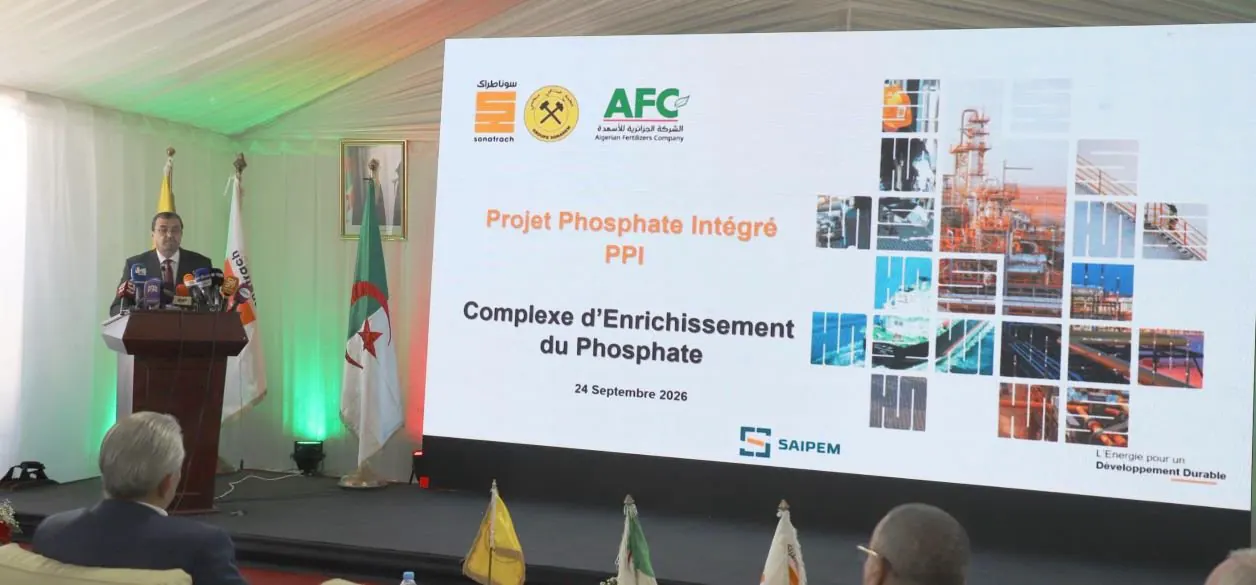
Algeria's long-awaited integrated phosphate project has entered its implementation phase, with several construction launches taking place across the country. The project, which aims to boost phosphate extraction, enrichment, and transformation, kicked off with ceremonies in Bled El Hadba, Tébessa, Oued Kebrit, Souk Ahras, and Annaba. The project's progress was overseen by Algerian Minister of Hydrocarbons Mohamed Arkab, along with his counterparts in Public Works and Basic Infrastructure, Abdelkader Djellaoui, and Mines and Mining Industry, Mourad Hanifi.
In Bled El Hadba, Tébessa, the government ministers laid the foundation stone for a complex dedicated to phosphate extraction and enrichment. The site is estimated to hold around 1.2 billion tons of phosphate reserves. According to Minister Arkab, Bled El Hadba constitutes the first link in the integrated project, which will see the extraction of 10.5 million tons of phosphate per year, with 5.5 million tons being enriched and commercialized. The site will supply the industrial pole in Oued Kebrit, Souk Ahras, for chemical transformation.
The industrial pole in Oued Kebrit, Souk Ahras, will host a chemical transformation complex and fertilizer production unit. Italian company SAIPEM is carrying out the works under the EPC Fast Track formula, which combines engineering, supply, and construction within an accelerated timeframe. Several subsidiaries of Sonatrach, including SARPI, GCB, and GTP, are also participating in the project. The complex will produce around 2.4 million tons of phosphated fertilizers and 570,000 tons of nitrogenous fertilizers annually.
In Annaba, the project's logistical component advanced with the official launch of port infrastructure works. The installations will enable the reception and loading of enriched phosphate, fertilizers, and related products onto ships for national, regional, and international markets. Minister Arkab stressed the importance of close coordination between sectors and companies involved, as well as reinforced monitoring of on-site work.
The integrated phosphate project spans several eastern Algerian provinces, including Tébessa, Souk Ahras, and Annaba. The project involves phosphate extraction and enrichment, industrial transformation, fertilizer production, transportation, and export. A 422-kilometer railway line, currently under construction, will link the provinces, facilitating phosphate transport from Bled El Hadba to Oued Kebrit and then to Annaba's port installations.
The project's organization aims to increase local phosphate transformation, supply the national market with fertilizers, boost non-hydrocarbon exports, and create jobs. Algerian authorities are counting on the project to drive economic growth and development in the region. The project's realization is a strategic objective for the Algerian government.
Two EPC contracts were signed on August 12 by Sonatrach and Algerian Fertilizer Company (AFC) for the project's first phase. The contracts, with Italian company Saipem and Chinese company CHEC, concern transformation and production installations, as well as port infrastructure. The project's implementation is expected to have a significant impact on Algeria's economy and phosphate industry.
Key points
- Algeria's integrated phosphate project aims to extract 10.5 million tons of phosphate per year.
- The project will produce around 2.4 million tons of phosphated fertilizers and 570,000 tons of nitrogenous fertilizers annually.
- A 422-kilometer railway line will link the provinces of Tébessa, Souk Ahras, and Annaba, facilitating phosphate transport.