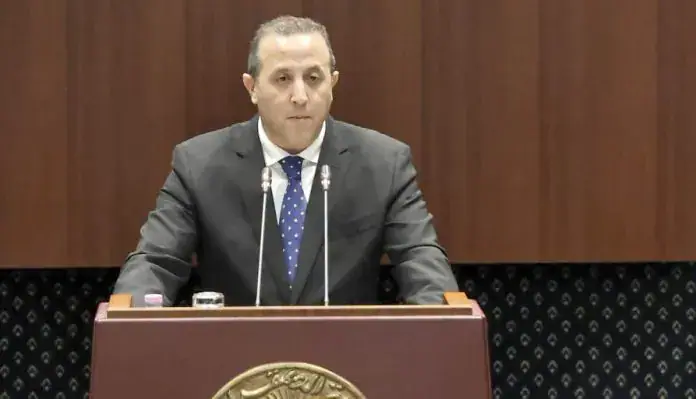
Algerian Finance Minister Mohamed Lamine Lebbou presented the 2027 finance bill to the National People's Assembly (APN) on November 3, 2026. The bill aims to support productive investment, diversify the national economy, and preserve purchasing power. The presentation was made during a plenary session presided over by APN President Khalida Boufedèche, with several government members in attendance. Lebbou highlighted that the bill was developed in a challenging international context marked by geopolitical uncertainties, inflationary pressures, and fluctuations in energy markets.
The 2027 finance bill proposes several measures to encourage productive investment, strengthen economic diversification, and preserve purchasing power. It also aims to expand the tax base, mobilize more resources, and simplify procedures. The bill includes provisions to modernize the administration, enhance tax compliance, and combat tax evasion and fraud. Additionally, it outlines customs and national domain measures. Lebbou emphasized that the bill seeks to reorganize the investment framework, citing the creation of three agencies responsible for investment promotion, a national investment council, and a one-stop investment shop.
To simplify procedures and modernize the administration, the bill proposes making remote declaration and payment mandatory for taxpayers subject to the unique flat tax (IFU). The bill also provides for the renewal of the value-added tax (VAT) exemption on imports and sales of dry vegetables, fresh fruits and vegetables, eggs, chicken, and turkey produced locally, until December 31, 2029. This move aims to support the local agricultural sector and maintain food prices.
According to Lebbou, the 2027 finance bill forecasts a 4.2% economic growth rate. Budget revenues are estimated at over 9,251.1 billion Algerian dinars, while expenditures are expected to reach 17,251.6 billion dinars in commitment authorizations and 17,882.6 billion dinars in payment credits. The bill also earmarks 4,356.64 billion dinars in commitment authorizations and 4,415.35 billion dinars in payment credits for transfer expenditures, primarily for subsidies on widely consumed products.
Lebbou also provided an update on the 2026 economic outlook, expecting a 4.3% growth rate, driven by the good performance of non-hydrocarbon activities, which are anticipated to grow at 4.8%. The hydrocarbon sector is also expected to recover, with a 1% increase. The nominal gross domestic product (GDP) is projected to exceed 48,723 billion dinars in 2026. The minister expects improved budget balances, resulting from revenue growth and stabilized expenditure levels.
The 2026 budget revenues are expected to surpass 8,611 billion dinars, while expenditures are estimated at over 17,636 billion dinars. The oil fiscal revenue is anticipated to improve, reaching 4,157.2 billion dinars, due to increased hydrocarbon exports. The expected surplus will be channeled into the Revenue Regulation Fund (RRF) to the tune of approximately 1,459 billion dinars.
Following the presentation of the 2027 finance bill, the APN plenary session continued with a debate among deputies on the various measures outlined in the bill. The discussion focused on the proposed reforms and their potential impact on the economy and citizens' purchasing power. Key points include:
Key points
- The 2027 finance bill aims to support productive investment and diversify the Algerian economy.
- The bill proposes measures to preserve purchasing power, including VAT exemptions on certain locally produced goods.
- A 4.2% economic growth rate is forecast for 2027, with budget revenues estimated at over 9,251.1 billion Algerian dinars.