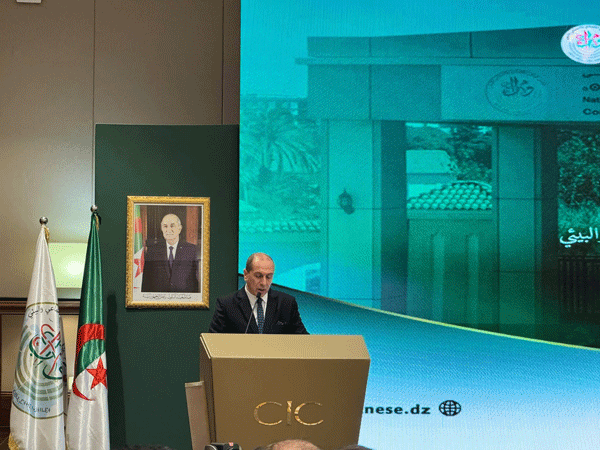
The National Economic, Social and Environmental Council of Algeria convened its third ordinary general assembly of 2026, chaired by Professor Mohamed Boukhari. The council discussed three key reports, including one on private tutoring outside official educational institutions, as per a directive from President Abdelmadjid Tebboune. This report aims to study the phenomenon's economic, social, and educational dimensions and its impact on the education system.
The report on private tutoring revealed that this phenomenon is not unique to Algeria, but also exists in countries like China, Korea, and other developed nations. However, the council emphasized the need to understand the causes and effects of private tutoring in the Algerian context. The council adopted a balanced and objective approach, listening to various stakeholders and parties interested in the subject, to develop effective and suitable solutions.
The second report discussed public service financing and the effectiveness of public institutions with industrial and commercial characteristics. This report was also initiated by President Tebboune, highlighting the challenge of balancing quality public services with financial sustainability and economic efficiency. The council sought to find a balance between the service and commercial aspects of these institutions.
The third report examined institutional synergy in breast cancer care in Algeria, as part of the council's self-initiated efforts. The report aimed to identify areas for improvement and enhance coordination among institutions involved in breast cancer prevention, diagnosis, treatment, and care. The council conducted a survey of relevant literature and experiences to develop a practical plan with measurable indicators and timelines.
Professor Boukhari emphasized that the council's work went beyond diagnosing problems, adopting a methodology that included reviewing literature, benchmarking international experiences, and consulting with stakeholders. The goal was to produce actionable recommendations and plans that could be monitored and evaluated, with clear indicators, timelines, and responsibilities.
The council's reports are expected to provide a consultative basis for decision-making, focusing on issues related to public service quality, education, and healthcare. The council's work aims to support public decision-making through analysis, foresight, and actionable proposals. Professor Boukhari expressed gratitude to President Tebboune for entrusting the council with these important national issues.
The council's discussions and recommendations are expected to contribute to improving public services, education, and healthcare in Algeria. The reports will likely inform policy decisions and guide future actions in these areas. Key points from the discussions include the need for effective solutions to address private tutoring, improved public service financing, and enhanced breast cancer care.
Key points
- The Algerian council discusses reports on private tutoring, public service financing, and breast cancer care to inform policy decisions.
- The council aims to develop actionable recommendations and plans to address these issues.
- The reports are expected to contribute to improving public services, education, and healthcare in Algeria.