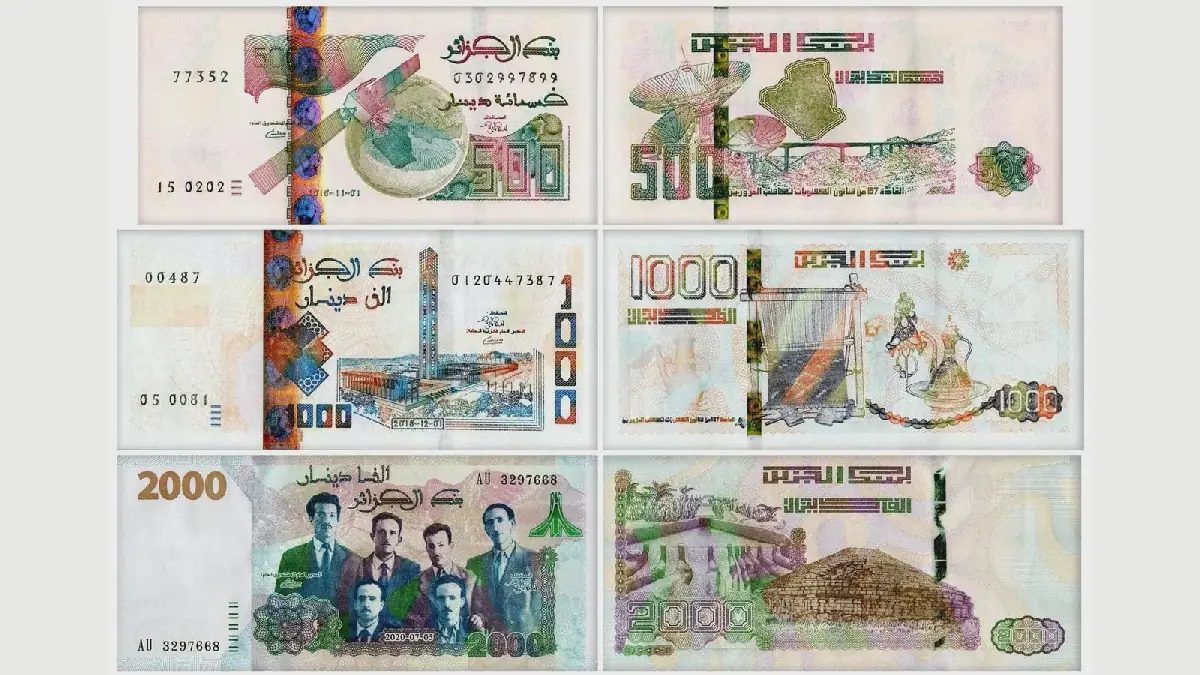
Algerian security services have recently dismantled several networks of counterfeiters, seizing large quantities of fake banknotes. In September 2026, the police seized nearly 190,000 Algerian dinars (DA) in counterfeit banknotes in Annaba. These operations highlight the risks associated with counterfeit currency in Algeria. The fake banknotes primarily target high-denomination notes, such as 2,000 and 1,000 dinars, often circulating in markets, shops, and private transactions.
To protect against financial losses, it is essential to be able to recognize genuine banknotes. Algerian authorities recommend three simple steps to verify the authenticity of a banknote. First, examine the banknote by transparency, checking for a watermark and a security thread. Second, tilt the banknote to check for holograms or color-changing images. Third, touch the banknote to verify its texture, which should be firm and particular due to its cotton-based material.
The 2,000 DA banknote, available in several models, has distinct security features. The 2011 model has a blue-green tone, with a watermark of Emir Abdelkader and a security thread with alternating silver and dark zones. It also features a 13mm-wide hologram with the image of Jughurta. The 2020 model, depicting six historical leaders of the Revolution, has a color-changing image of the Maqam Echahid and a metallized security thread.
The 1,000 DA banknote, introduced on December 1, 2018, features the Grand Mosque of Algiers and has a watermark of Emir Abdelkader with the numeral "1000" below the bust. It also has a 5mm-wide security thread with the logo of the Banque d'Algérie and the numeral "1000", as well as a 13mm-wide hologram. The 500 DA banknote, issued in 2018, features the Alcomsat-1 satellite and has a watermark of Emir Abdelkader with the numeral "500".
Older banknotes, part of the "Histoire et patrimoine" series issued between 1992 and 1998, remain in circulation. These banknotes have different security features, including a watermark of an animal specific to each denomination, such as a buffalo for the 1,000 DA and an elephant for the 500 DA. The 1998 versions of the 1,000 and 500 DA banknotes feature a 13mm-wide hologram with the word "Banque" in Arabic and the busts of Emir Abdelkader and Jughurta.
If a counterfeit banknote is received, it should not be returned to circulation. The article 197 of the penal code punishes counterfeiters, and passing a fake banknote can lead to prosecution. Instead, the banknote should be reported to the police or presented to a bank, along with any information about the person or business that provided it.
Genuine banknotes that are damaged can be exchanged at the Banque d'Algérie under certain conditions. Citizens are advised to be vigilant and take steps to verify the authenticity of banknotes to avoid financial losses. By being aware of the security features and taking simple precautions, individuals can protect themselves against counterfeit currency.
Key points
- Algerian authorities have seized thousands of dinars in counterfeit banknotes, highlighting the need for vigilance.
- The Banque d'Algérie has outlined security features for genuine banknotes, including watermarks, security threads, and holograms.
- Citizens are advised to report counterfeit banknotes to the police or present them to a bank, rather than returning them to circulation.