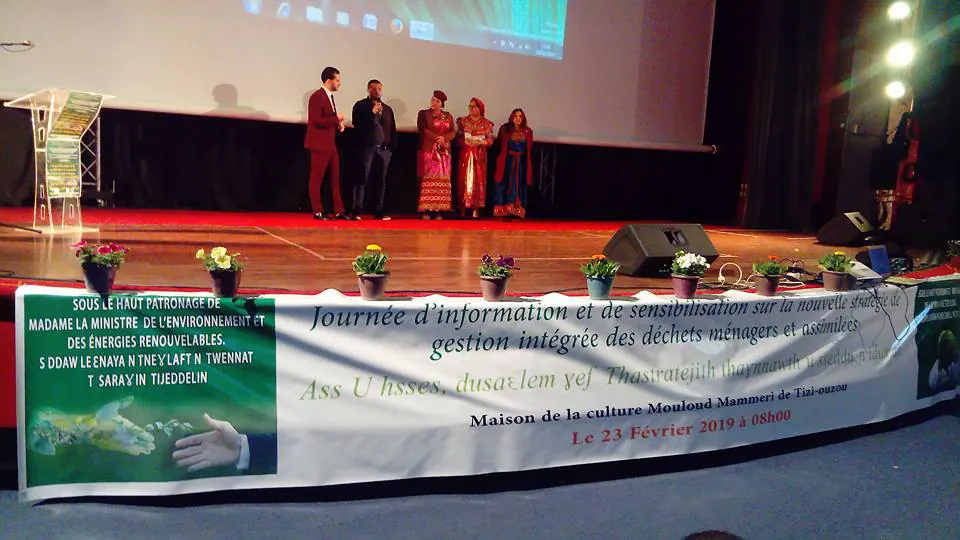
A recent study day was held at the Mouloud Mammeri cultural center in Tizi-Ouzou to discuss the new strategy. The event was organized by the Mouloud Mammeri University in collaboration with the Tizi-Ouzou wilaya's environmental department. Participants emphasized the need for urgent action to preserve the environment and manage waste sustainably. A video was shown highlighting the alarming state of waste disposal in the region, with rivers, coastlines, roads, forests, and plains all affected by pollution.
The video revealed that local authorities, known as APCs, are not fulfilling their role in waste management, and education on the issue is lacking. This has led to the proposal for the creation of an "environmental police" to address the problem. The report also noted that the existing waste disposal centers, known as CETs, quickly become saturated due to a lack of waste sorting, composting, and recycling. Furthermore, citizens' opposition to the construction of CETs near their villages and homes has hindered efforts to address the issue.
The study day also highlighted the issue of incivicism, which exacerbates the problem of waste disposal. The dangers posed by the proliferation of waste were discussed, including the risk of environmental and health problems. However, the video also showcased successful initiatives in certain villages, such as Bouzeguène, where residents have implemented effective waste management systems, including sorting, composting, and recycling. The village of Taourirt was cited as a notable example of a successful waste management project.
The new national waste management strategy aims to generalize the experience of Bouzeguène and provide a solution to the problem of waste disposal. However, the issue of incinerating non-recyclable waste remains a challenge. Experts suggest that alternative solutions, such as CETs reserved exclusively for non-recyclable waste, should be explored. The event was attended by high-ranking officials, including the secretary general of the Tizi-Ouzou wilaya, Zinedine Tirbourtine, and representatives from the Ministry of Environment.
The first conference of the study day was delivered by Mme Hamedi Siad Nabila, who discussed the history of waste management in Algeria. She noted that Algeria has been aware of the importance of environmental protection since the 1970s and has participated in international conferences on the issue, including the 1972 Stockholm conference. Algeria adopted its first law on environmental protection in 1983, and the concept of sustainable development was integrated into national policy in 1992.
Mme Hamedi Siad Nabila emphasized that Algeria has made significant progress in environmental protection, including the creation of a constitutional right to a healthy environment in 2016. She expressed her conviction that solutions to the waste management problem exist and that a long-term effort to educate and involve citizens, particularly women, is necessary to address the issue. She cited the example of Bouzeguène, where residents have successfully implemented waste management initiatives.
The second conference was delivered by M. Hammoum Arezki, who presented a scheme for the sustainable management of household waste in the Tizi-Ouzou wilaya. He noted that 70 villages in the region have begun to implement waste sorting, composting, and recycling initiatives, and that the commune of Tizi-Ouzou spends 16 billion dinars per year on waste collection, with limited results. M. Hammoum emphasized the need for a new approach to waste management, including the creation of CETs and the implementation of education and awareness campaigns.
Key points
- The new national waste management strategy aims to generalize successful initiatives, such as those implemented in Bouzeguène, and provide a solution to the problem of waste disposal in Algeria.
- The strategy includes the creation of CETs and the implementation of education and awareness campaigns to address the issue of waste disposal.
- Algeria has made significant progress in environmental protection, including the creation of a constitutional right to a healthy environment in 2016.