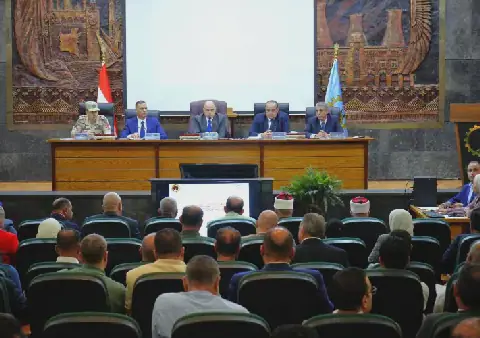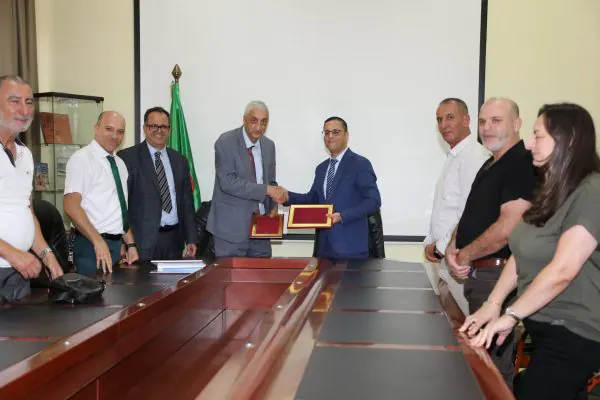
The Ecole nationale supérieure d'agronomie (ENSA) in Algeria has taken a significant step towards integrating climate factors into national forecasting strategies by launching a project to establish an automatic meteorological and climatic station. This initiative is a result of a cooperation and partnership agreement signed between ENSA and the Office national de la météorologie (ONM) on September 27, 2026. The agreement was signed by Tarik Hartani, director of ENSA, and Sidi Ahmed Hammadi, director of exploitation at ONM.
The partnership aims to enhance ENSA's infrastructure and pedagogical equipment to keep pace with developments in agronomic sciences, particularly in the context of climate change and its impact on agricultural production. The meteorological and climatic station will be built within the ENSA premises, with a chosen site and a defined action plan to commence the project. This collaboration will facilitate the collection of local microclimatic data to optimize irrigation, prevent frost, and adapt crops to changing conditions.
The project is crucial for Algerian agriculture, as it seeks to improve crop yields and adapt to climate change. Currently, the country's cereal yield ranges from 12 to 15 quintals per hectare, with potential to increase to 20-25 quintals per hectare. ENSA's director, Tarik Hartani, emphasized the importance of considering climate factors in national forecasting strategies to achieve this goal. He also highlighted the institution's selection by the Islamic Development Bank (BID) as one of the centers of excellence.
The ENSA-ONM partnership will also facilitate participation in international research projects, such as the PRIMA program and Horizon Europe. Abdelkader Laribi, deputy director of ENSA, mentioned the potential for collaboration on research initiatives. The ONM's Sidi Ahmed Hammadi noted that ENSA was chosen as a partner for the "Towards Smart Agricultural Management" program, conducted in cooperation with the BID.
The agreement between ENSA and ONM also includes provisions for exchanging scientific publications and information relevant to both parties. The two institutions have highlighted the importance of a recently published report, "Future Scenarios, Climate, and Impacts on Agriculture," commissioned by the Ministry of Agriculture. This report is expected to inform decision-making on agricultural development and climate change mitigation.
The partnership between ENSA and ONM reflects a broader effort to address the challenges posed by climate change to Algerian agriculture. By integrating meteorological and climatic data into agricultural planning, the country's farmers and policymakers can make more informed decisions to improve crop yields and resilience. The project is expected to contribute to the development of more effective agricultural strategies and better management of climate-related risks.
The implementation of the meteorological and climatic station project is seen as a key step towards achieving these goals. With the support of the ONM and other partners, ENSA is well-positioned to play a leading role in promoting climate-resilient agriculture in Algeria. The project's success is expected to have a positive impact on the country's agricultural sector and contribute to its long-term sustainability.
Key points
- The ENSA-ONM partnership aims to improve agricultural forecasting and yields through the establishment of a meteorological and climatic station.
- The project seeks to integrate climate factors into national forecasting strategies and adapt agricultural practices to changing conditions.
- The partnership will facilitate collaboration on research initiatives and the exchange of scientific publications and information.