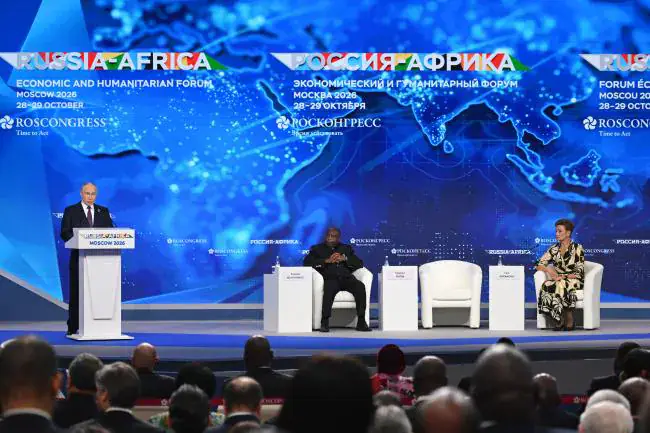
The third Russia-Africa summit kicked off in Moscow, with 48 African countries participating, including 22 represented at the level of heads of state. This significant turnout underscores the importance Moscow places on this event and the interest African capitals have shown despite Western pressure. The Algerian delegation, led by Prime Minister Sifi Ghrieb, is promoting a vision of multipolar partnership that does not exclude the country's solid relationship with Moscow.
The summit has necessitated a considerable security deployment, with barricades and a dense police presence securing the Kremlin's surroundings, hotels, and conference center. Russian authorities have also restricted mobile internet access in several central Moscow neighborhoods during the summit. A business salon featuring Russian companies, including Rosatom and Rosoboronexport, has been set up on the sidelines of the plenary sessions, showcasing solutions for African countries.
Rosatom is presenting its civil nuclear solutions, including low-power plants, nuclear medicine, and engineer training. Rosoboronexport is exhibiting a multi-layered air and drone defense system designed to counter asymmetric threats faced by several African armies. Algerian ministers, including Ahmed Attaf and Mohamed Arkab, are accompanying Prime Minister Ghrieb, reflecting Algeria's dual priorities: diplomacy and energy.
On October 27, the Gas Exporting Countries Forum (GECF) summit took place in Moscow, where participants adopted a declaration reaffirming the sovereign right of exporting states to manage their natural resources. The declaration emphasizes the role of gas as a stable energy source and essential input for fertilizers and global food security. Algeria views this text as a useful foundation for defending exporters' interests against market pressures and external regulation.
Algerian President Abdelmadjid Tebboune, in a statement read by Prime Minister Ghrieb, stressed the need to consolidate the GECF's role and strengthen cooperation among its members to ensure market stability and secure supplies amid geopolitical tensions. Tebboune highlighted Algeria's commitment to being a reliable supplier, citing its ranking as one of the top ten global gas producers and second-largest supplier to the European Union via pipeline.
The Algerian president also mentioned the country's program to develop 15,000 megawatts of renewable energy by 2035 and the South Hydrogen Corridor project, which aims to export gas, electricity, ammonia, and hydrogen. He emphasized the trans-Saharan gas pipeline project, with a capacity of around 30 billion cubic meters per year, as a symbol of African unity and cooperation.
Russia presents its approach as one that respects sovereignty and non-interference, differing from what it perceives as Western conditionality. While the exchanges between Russia and Africa remain modest globally, they have been increasing, driven by agricultural and energy exports. In 2025, trade with Africa reached $27.7 billion, with Russia among the top suppliers of cereals and fertilizers to the continent.
Key points
- Algeria promotes a multipolar partnership at the Russia-Africa summit.
- The summit features a considerable security deployment and restricted internet access.
- Algeria emphasizes its commitment to being a reliable energy supplier and promoting African unity.