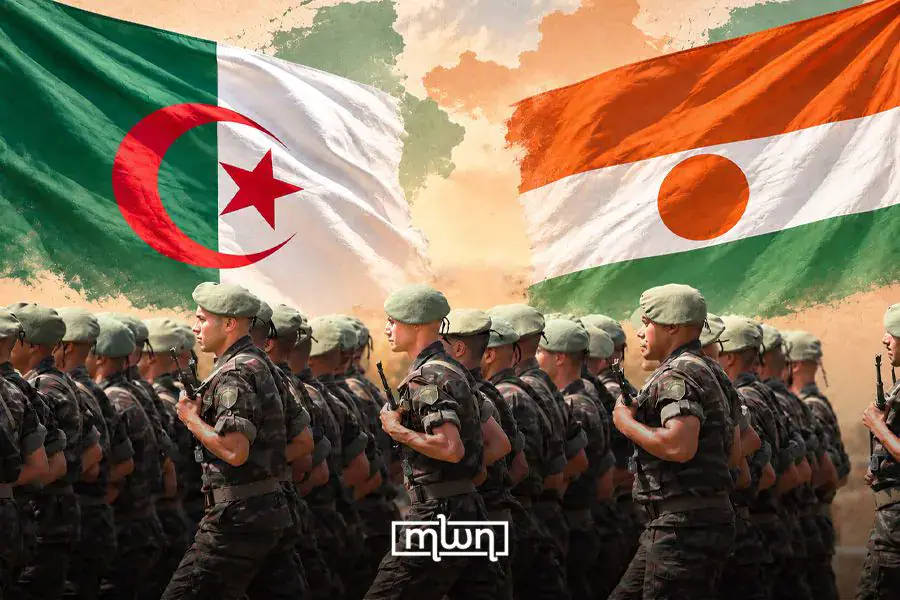
Algeria has abandoned its long-standing non-interventionist foreign policy by deploying National People's Army units to neighboring Niger. This move marks a significant shift in Algiers's approach, as it seeks to counter the growing influence of Morocco, the United Arab Emirates, and Libya's Marshal Khalifa Haftar in the Sahel region. The decision was made in response to a wave of sovereigntist coups in the Sahel that expelled France and the West.
The deployment of Algerian troops to Niger was approved by deputies and senators on October 25, with the aim of protecting energy interests and enhancing regional security. Algeria's past military interventions were limited to exceptions such as the 1967 and 1973 Arab-Israeli wars and a brief involvement in the Lebanon war in 1976. The recent move is seen as a bid to reconquer the Sahelian "backyard" that Algeria lost at the start of the 2020s.
Algeria's return to Niger is also driven by a desire to counter the influence of the UAE, Morocco, and Haftar's Libya. On August 9, Algeria provided Niger with four attack helicopters, and on August 30, it sent an air detachment, including four Su-30 fighters and two Ilyushin aircraft, to Niamey's Diori Hamani airport. A Nigerien officer indicated that Algerian air elements may be deployed more permanently in Niamey, with troops to guard them.
The legal basis for the deployment is thin, as the 2020 constitutional revision only allows for "peacekeeping missions" under UN, African Union, and Arab League principles. However, Algeria justified the move by citing the protection of energy interests, including the Kafra oil block and the 4,200-km trans-Saharan pipeline meant to carry Nigerian gas to Europe through Niger.
The deeper driver of Algeria's move is anxiety about the growing influence of Haftar's Libya, which has warm ties with the UAE and Morocco. Haftar's advance toward the corridors linking Libya to Niger worries the Algerian general staff, which sees a threat from the convergence of Emirati, Moroccan, and Israeli interests. Algeria has already broken off diplomatic relations with Abu Dhabi.
Niger also brokered Algeria's reconciliation with Mali, which had been in crisis for 15 months. The two countries resumed dialogue in early July, encouraged by Russia, which protects the Malian junta. Algeria's aim is to restore its role as mediator and revive the 2015 Algiers peace accord, which the Malian junta buried in early 2024.
The cost of Algeria's return to the Sahel may fall on the region itself, as it exposes the military weakness of the Alliance of Sahel States. The move also raises concerns about the potential for neo-imperialism, with Algeria taking on a more conventional posture as a power willing to project force abroad.
Key points
- Algeria shifts policy, deploying troops to Niger to counter Morocco-UAE-Libya axis.
- The move marks a significant shift in Algiers's non-interventionist foreign policy.
- Algeria aims to protect energy interests and enhance regional security in the Sahel.