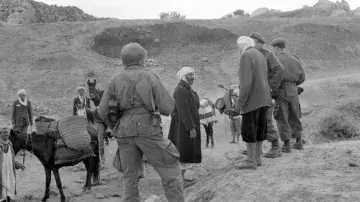
Algeria experienced a significant decline in population under French occupation, with a recorded decrease of nearly half a million people between 1851 and 1856. The first census conducted by French authorities in 1851 reported a population of 2.824 million, which dropped to 2.310 million by 1856. This decline was attributed to various factors, including resistance movements and revolts against French rule. The population continued to fluctuate, with a slight increase to 2.737 million by 1861, but then decreased again to 2.656 million by 1866.
The French occupation of Algeria, which began in 1830, had a profound impact on the country's demographics. The imposition of French laws and policies, including the confiscation of land from the Turkish government and the establishment of European settlements, contributed to the displacement and marginalization of the indigenous population. The population decline during this period was also influenced by the violent suppression of resistance movements, including the revolt led by Ahmed Bey in 1871.
The French census data suggests that the population of Algeria began to grow steadily after the 1870s, with a reported increase from 2.134 million in 1872 to 3.577 million by 1891. However, this growth was largely driven by the influx of European settlers and the expansion of French colonial rule. The population continued to grow, reaching 4.741 million by 1911 and 5.588 million by 1931. However, this growth was not accompanied by improvements in living standards or economic opportunities for the indigenous population.
The period of French occupation also saw significant changes in Algeria's demographic composition. The influx of European settlers, who were attracted by the country's natural resources and economic opportunities, led to a shift in the balance of power in favor of the colonial authorities. The indigenous population, which had been displaced and marginalized, continued to resist French rule, with the outbreak of the Algerian War of Independence in 1954 marking a significant turning point in the country's history.
The Algerian War of Independence, which lasted from 1954 to 1962, had a profound impact on the country's population. The conflict led to the displacement of hundreds of thousands of people, with many Algerians fleeing to neighboring countries or seeking asylum abroad. The war also resulted in significant human losses, with estimates suggesting that up to 1 million Algerians died during the conflict.
After gaining independence in 1962, Algeria experienced rapid population growth, driven by a combination of factors, including the return of Algerian refugees from abroad and high birth rates. The population grew from approximately 10 million in 1962 to 12.018 million by 1966, and continued to increase steadily, reaching 18.250 million by 1977 and 23.050 million by 1987. However, this growth was also accompanied by significant economic and social challenges, including high levels of poverty and unemployment.
In recent years, Algeria's population growth has slowed, with the population increasing from 32.364 million in 2004 to 32.906 million by 2005. This slowdown has been attributed to a range of factors, including declining birth rates and the impact of economic and social challenges on family planning decisions. Despite these challenges, Algeria's population is expected to continue growing, with estimates suggesting that the country will reach a population of over 40 million by 2025.
Key points
- The French occupation of Algeria led to a significant decline in the country's population, with a recorded decrease of nearly half a million people between 1851 and 1856.
- The Algerian War of Independence had a profound impact on the country's population, leading to significant human losses and displacement.
- Algeria's population growth has slowed in recent years, driven by declining birth rates and economic and social challenges.