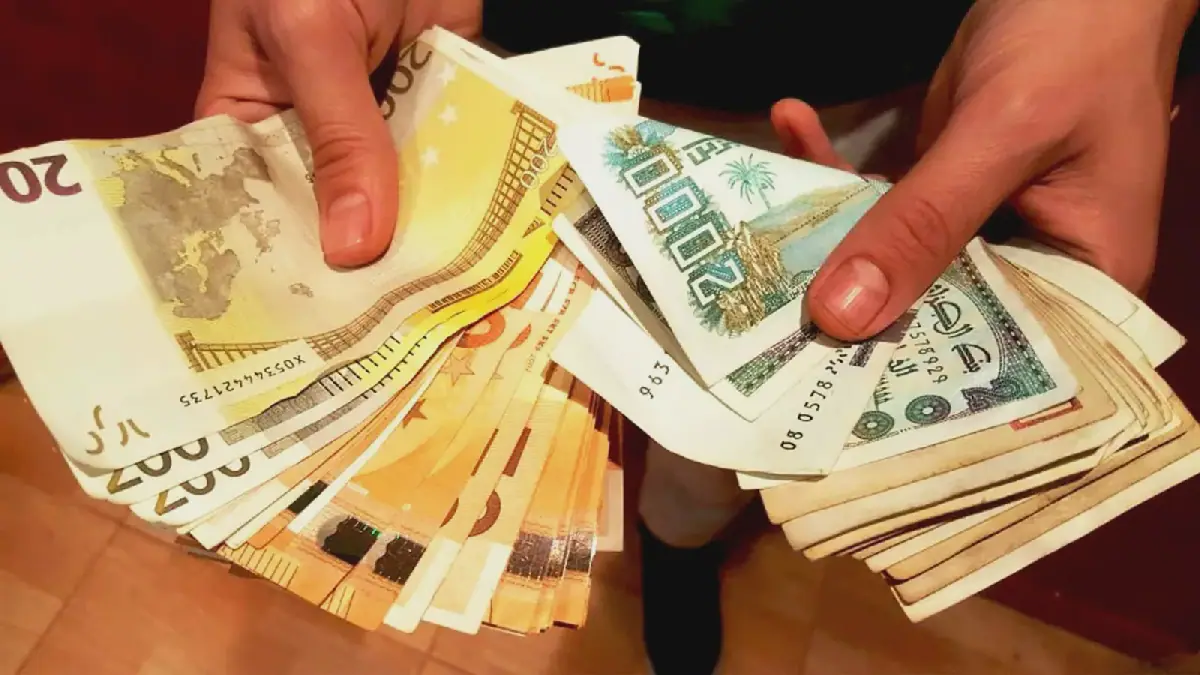
The parallel currency market in Algeria has concluded October with a relative stability, with major foreign currencies displaying minimal fluctuations. At Square Port-Saïd in Algiers, the main reference point for the parallel market, the euro is trading at 274 Algerian dinars for purchase and 276 dinars for sale. This stability has sparked questions about whether this calm will persist or give way to a resurgence in transactions as November begins.
Other major currencies also show stability, with the US dollar trading at 240 dinars for purchase and 242 dinars for sale. The Canadian dollar is offered at 171 dinars for purchase and 173 dinars for sale, while the British pound reaches 314 and 318 dinars, respectively. This stability is not limited to these currencies, as several other foreign currencies tracked by individuals also show minimal fluctuations.
The Swiss franc is trading at 294 dinars for purchase and 298 dinars for sale, while the Chinese yuan is quoted at 34.50 dinars for purchase and 36.50 dinars for sale. Among Arab currencies, the Saudi riyal is at 63 dinars for purchase and 65 dinars for sale, and the Qatari riyal reaches 65 and 67 dinars. The Emirati dirham is offered at 64 and 66 dinars, and the Tunisian dinar stands at 79 dinars for purchase and 81 dinars for sale.
The Egyptian pound is traded at 4 dinars for purchase and 4.50 dinars for sale. As the market approaches November, many questions arise about the future trend. Several factors could influence this trend, particularly the evolution of supply and demand on the parallel market. The needs of individuals in foreign currencies and the availability of currencies could weigh on future exchange rates.
Despite these factors, it is currently impossible to predict with certainty whether there will be an increase or decrease in the main currencies. The market could either maintain its current trend or experience new movements in the coming weeks. The question remains whether November will mark a change in dynamics for Algeria's parallel currency market or if the stability observed in October will continue until December.
The stability of the parallel currency market in Algeria has significant implications for the country's economy. A stable market can encourage investment and facilitate trade, while fluctuations can create uncertainty and impact the purchasing power of individuals. As the market continues to evolve, individuals and businesses will be closely watching exchange rates to make informed decisions.
The journalist Wissam, who covers national news, social issues, and current events in Algeria, notes that the market's future trend will depend on various factors, including supply and demand. As the situation continues to unfold, one thing is certain: the parallel currency market in Algeria will remain an important indicator of the country's economic health.
Key points
- The parallel currency market in Algeria has shown relative stability as November approaches.
- Major foreign currencies, including the euro and US dollar, display minimal fluctuations.
- The market's future trend will depend on various factors, including supply and demand.