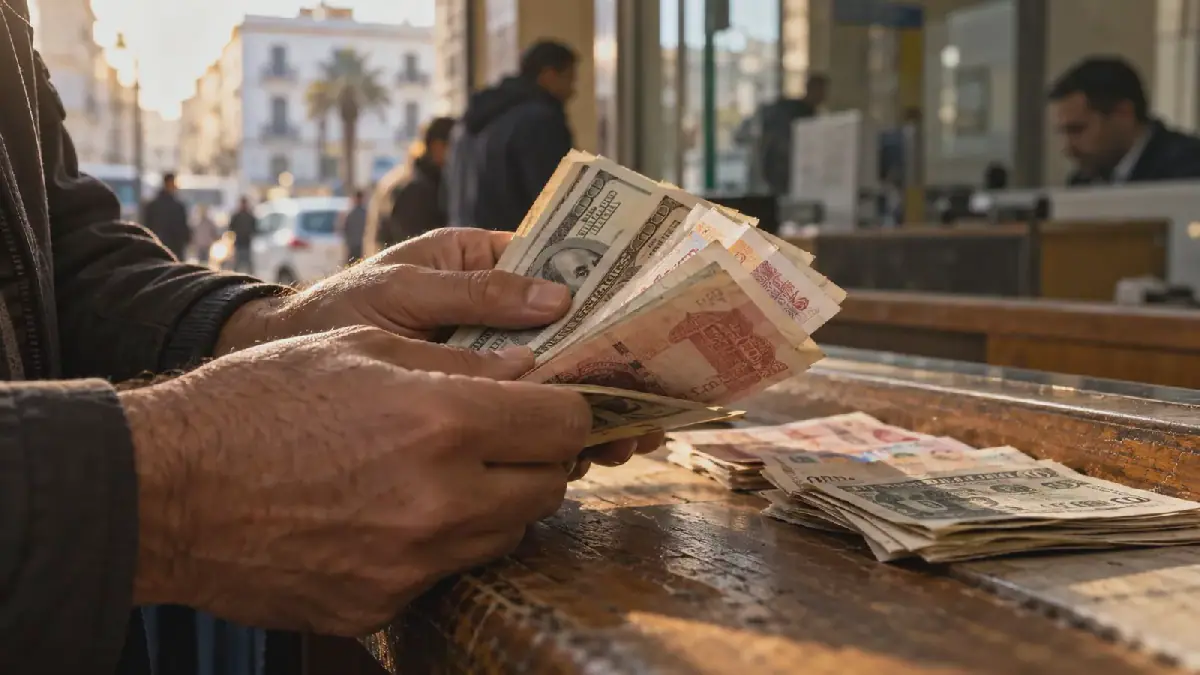
The International Fund for Agricultural Development (IFAD) has reported that Algeria's diaspora sent $1.799 billion in remittances in 2025, placing the country 11th in Africa. This figure is significantly lower than that of Morocco, which received $13.65 billion, and Tunisia, which received $3.25 billion. According to IFAD's report "Sending Money Home 2026," the $1.8 billion puts Algeria behind Ghana and just ahead of Côte d'Ivoire.
The $1.8 billion figure represents a decline from previous years, with remittances reaching $1.942 billion in 2024 and $1.868 billion in 2023. Over the past decade, Algeria has lost ground, dropping from being among the top five African recipients in 2016 to 11th place. In contrast, Ethiopia and Kenya have taken Algeria's former position, along with Ghana. The IFAD report also notes that remittances to Africa reached $124.2 billion in 2025, an 86% increase over the past decade.
Zoheir Rouis, vice-president of Jil Jadid, disputes the idea that the $1.8 billion figure accurately reflects the generosity of Algeria's diaspora. He argues that the IFAD report only accounts for remittances made through official channels, such as banks and money transfer operators. Rouis claims that the significant gap between the official exchange rate and the parallel market rate, ranging from 53% to 80%, encourages individuals to send money through unofficial channels.
Rouis also notes that some remittances are sent in cash, hand-delivered during visits, and therefore not recorded in official statistics. He advocates for a reform of the conditions for transferring currencies, citing the need for simpler, safer, and more competitive official channels. The current gap between official and parallel market rates remains high, with the euro valued at around 80% more on the parallel market than at the official rate.
Rouis compares Algeria unfavorably to Morocco and Tunisia, arguing that their policies have made formal transfers more accessible and attractive. He questions why Algeria's economy cannot provide its diaspora with simple, safe, and competitive channels for sending remittances. Rouis suggests that Algeria's diaspora could contribute more to the economy, beyond just family support, by investing in small and medium-sized enterprises, transferring technology, and promoting research and innovation.
Rouis proposes a comprehensive reform of the conditions for transferring currencies, including reducing the gap between official and parallel market rates, modernizing banking circuits, and developing digital solutions. He also recommends creating attractive savings products in foreign currencies, facilitating diaspora investment in Algerian SMEs, and establishing simple mechanisms for researchers, engineers, and entrepreneurs to contribute to projects in Algeria.
The Algerian authorities have already taken steps to engage with the diaspora and improve the foreign exchange market. The Banque extérieure d'Algérie obtained an agrément in France in January 2025 and opened its first three agencies in Paris, Saint-Denis, and Marseille in November 2025. Additional agencies are planned for 2026 in Bordeaux, Lille, and Lyon.
Key points
- Algeria's diaspora sent $1.8 billion in remittances in 2025.
- The figure underestimates the actual amount, as many transfers are made through unofficial channels.
- Experts advocate for reforms to make official channels more attractive and competitive.