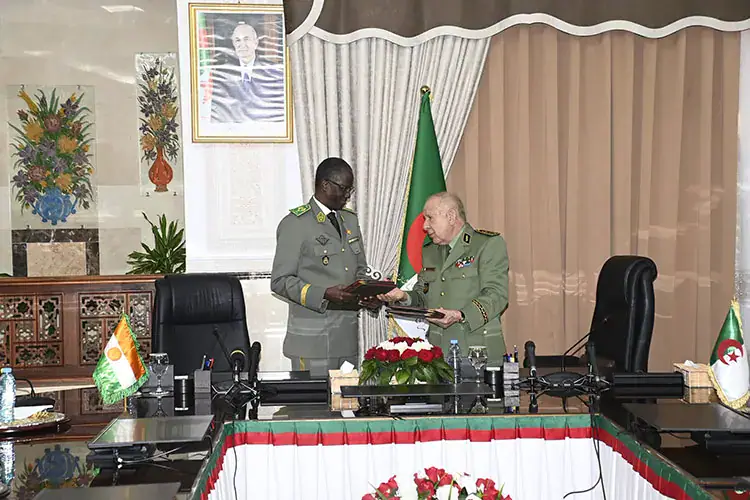
The European Union's demand for clarification on Algeria's deployment of military units in Niger has sparked criticism in Algeria. The deployment, approved by parliament, falls under a bilateral military agreement between Algeria and Niger, and was carried out at Niger's request. Algeria's former ambassador to Madrid and Mexico City, Abdelaziz Rahabi, questioned the EU's authority to demand explanations, stating that the agreement concerns only the two sovereign states involved.
The EU's position, expressed by its spokesperson for Foreign Affairs and Security Policy, Anouar El Anouni, has raised questions about the limits of Brussels' role in the Sahel. The EU is closely monitoring the deployment and seeking clarification on its scope, objectives, and legal basis. Rahabi criticized the EU's statement, arguing that it implies a level of oversight that is not justified, and that Algeria is not bound by a conventional commitment to the EU on these issues.
Rahabi's criticism reflects a broader rejection of what he sees as an implicit European claim to political oversight over decisions taken by sovereign African states. He warned that if the EU continues to demand explanations, it could expose itself to similar demands from Algiers. Rahabi also argued that the EU has persistent inability to move beyond outdated perceptions of Africa, and that it has no grounds to question the sincerity of its partners or the sovereignty of their domestic mechanisms.
Former parliamentarian Lakhdar Rezzag Baara linked the European position to the broader transformations taking place across the Sahel. He argued that certain European capitals have yet to come to terms with the fact that the region is no longer an open arena for their traditional influence. Baara stated that Algeria has moved beyond merely monitoring threats along its southern borders and is now taking the initiative to protect its strategic interests.
Baara also drew attention to allegations that France, the United Arab Emirates, and Israel have been undertaking efforts within European circles to push for sanctions against Algeria and Niger over their military and economic cooperation agreements. He linked these allegations to attempts to exert political and diplomatic pressure on Algeria and obstruct its strategic engagement in the Sahel.
Military historian and researcher Tewfik Hamel argues that the transformations in the region since the 2011 Libyan war have rendered the traditional distinction between domestic security and developments in neighbouring countries increasingly inadequate. He cites the spread of armed groups and weapons-smuggling networks, which now extend across borders, as a reason for Algeria's shift towards direct involvement in safeguarding its interests and shaping regional balances of power.
The criticism comes as Algeria and Niger continue to deepen cooperation across several fields, amid overlapping security and economic challenges. Algeria's decision to deploy military units in Niger was taken through its own constitutional mechanisms, at Niger's request, and within the framework of bilateral cooperation. The EU's monitoring of developments in the region does not confer on its institutions the right to question sovereign states about their bilateral agreements.
Key points
- Algeria rejects European oversight of its military deployment in Niger, citing sovereignty and bilateral agreement.
- The EU's demand for clarification on the deployment has sparked criticism in Algeria.
- The deployment reflects a shift in Algeria's approach to regional security, with a focus on direct involvement in safeguarding its interests.
Reporting sources
- No European Oversight of Algeria–Niger Sovereign Agreement · echoroukonline.com