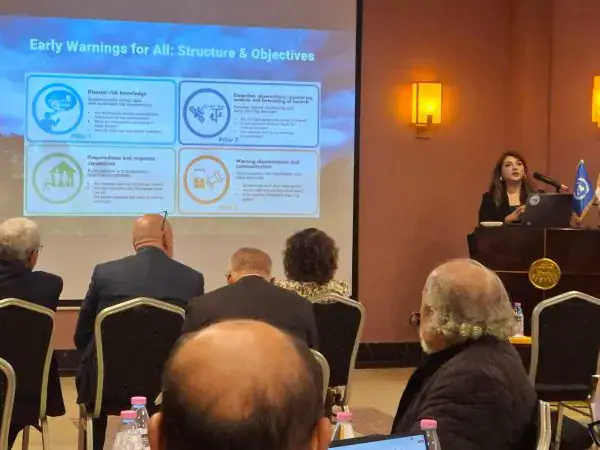
The Algerian government has officially launched a national program under the global initiative "Early Warnings for All," aimed at designing an integrated system to disseminate direct and multi-risk alerts to the entire population. The program, led by the Ministry of Interior, Local Authorities, and Territorial Planning, brings together ministries, technical experts, and UN agencies to address climate and geological threats. This initiative marks a strategic international cooperation effort.
The program involves four major UN humanitarian and scientific organizations: the UN Office for Disaster Risk Reduction (UNDRR), the World Meteorological Organization (WMO), the International Telecommunication Union (ITU), and the International Federation of Red Cross and Red Crescent Societies (IFRC). Their participation highlights Algeria's commitment to aligning with the highest global standards in crisis management. The goal is to transition to a proactive, comprehensive protection model.
The national strategy is aligned with recent legislative reforms, including Law No. 04-24 on major risk prevention and disaster management, and the 2025-2035 national strategy. The initiative focuses on four pillars: in-depth risk assessment, surveillance and forecasting, optimizing information dissemination channels, and enhancing on-ground response capabilities. These pillars are designed to operationalize the law and structure Algeria's response to disasters.
A key aspect of the program is the modernization of detection tools, including those of the National Meteorological Office (ONM) and the Research Center in Astronomy, Astrophysics, and Geophysics (CRAAG). The system aims to provide real-time alerts, even to remote areas, and strengthen population preparedness and coordination with rescue services. The use of cell broadcast technology is being explored to send emergency notifications directly to mobile phones.
The program also emphasizes the importance of digitalization in alert systems, with discussions focusing on interconnection modalities between technical surveillance centers and national telecommunications networks. Algeria aims to deploy a cell broadcast system that can instantly transmit emergency notifications and safety instructions to citizens' mobile phones in areas of imminent danger.
The initiative brings together climatologists, telecommunications engineers, rescue teams, and policymakers, promoting an unprecedented dialogue. The goal is to create a synergy that accelerates the country's transition to a proactive protection model, prioritizing anticipation over post-crisis management. The event's outcome will be a roadmap for implementing technical infrastructures and sectoral commitments.
The final recommendations and operational roadmap from the two-day event will be presented and adopted, outlining each sector's commitments and deployment schedules. This will solidify Algeria's commitment to a safer, more resilient future in the face of natural hazards. The program is a significant step towards enhancing citizen safety and protecting the national socio-economic fabric.
Key points
- Algeria launches national program for major risk prevention with early warning systems
- Initiative involves strategic international cooperation with UN agencies
- Program aims to transition Algeria to a proactive, comprehensive protection model
Reporting sources
- Prévention des risques majeurs : Un plan national pour la sécurité des citoyens · Le Jeune Indépendant