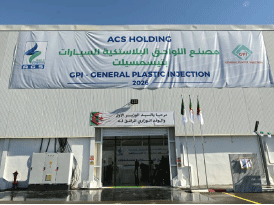
The Algerian government has launched the General Plastics Injection unit in Tissemsilt, a project aimed at expanding the country's industrial production base. The unit, located in the Sidi Mansour industrial zone, was inaugurated by the Prime Minister and is expected to play a significant role in supporting various industrial sectors. With a production capacity of 30,000 tons per year, the unit will provide technical plastic components that can be used in multiple industries.
The General Plastics Injection unit has been revived as part of the government's efforts to reactivate seized projects and reintegrate them into the economic cycle. The project, which began in April 2026, was completed in just five months, with the unit now ready for operation. The facility will produce 12,500 plastic pieces, with a potential output of 251,000 pieces per year, enough to equip around 200,000 vehicles. This will help create a local base of technical plastic components for the automotive industry and other sectors.
The unit's production will not be limited to the automotive sector, as its products can be used in various industries, including household appliances, cable manufacturing, refrigeration, and air conditioning. Additionally, the unit's products can be used in medical equipment, packaging, and household items, making it a versatile industrial base. This diversification of activities is a key aspect of the project, as it allows for greater integration with other national industries.
The project's impact on the local economy is expected to be significant, with the creation of 300 direct jobs and 500 indirect jobs. The unit's operation will also stimulate commercial activity, develop transportation and logistics services, and create new opportunities for businesses in the surrounding area. The project's revival is also seen as a way to support the national economy by promoting local production and reducing reliance on imports.
The General Plastics Injection unit is part of a broader strategy to build more integrated production and supply chains in Algeria. By providing local components, the unit will help strengthen relationships between national businesses and promote the use of locally produced inputs. This approach is in line with the government's efforts to encourage productive investment and develop national production capacities.
The project's success is also seen as a way to support the development of Algeria's mechanical industry and promote the growth of related industries. With its ability to produce a wide range of plastic components, the General Plastics Injection unit is expected to play a key role in the country's industrial development. The unit's operation will also help reduce the country's reliance on imported components and promote local production.
The Algerian government has set a deadline of December 31 for the import of plastic components for the automotive industry, highlighting the importance of local production in meeting domestic demand. The General Plastics Injection unit is expected to make a significant contribution to meeting this goal, and its success will be closely watched by industry stakeholders and government officials.
Key points
- The General Plastics Injection unit has a production capacity of 30,000 tons per year and will provide technical plastic components for various industries.
- The project is expected to create 300 direct jobs and 500 indirect jobs, stimulating commercial activity and promoting local production.
- The unit's operation will help reduce Algeria's reliance on imported components and promote local production, supporting the country's industrial development.