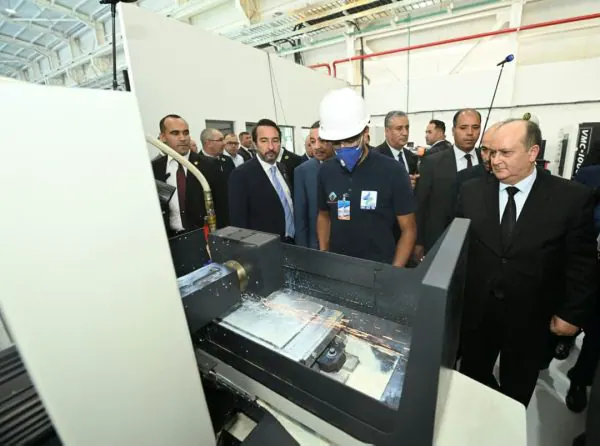
The Algerian government has inaugurated a new factory in Tissemsilt, producing plastic components and accessories for automobiles. The factory, part of the Holding Algeria Chemical Specialities, is a significant step towards increasing local integration in the automotive industry. The project is a result of a 5 billion Algerian dinar investment, started in April, and aims to produce 251,000 pieces per year, enough to equip nearly 200,000 vehicles.
The factory was inaugurated by Algerian Prime Minister, Sifi Ghrieb, in the presence of several ministers, including the Minister of Interior, Local Authorities, and Transport, Saïd Sayoud, and the Minister of Industry, Farid Kourtel. The Prime Minister emphasized the government's commitment to increasing local integration and reducing imports of components that can be produced locally. He stressed that it is no longer acceptable to continue importing plastic parts that can be easily manufactured in Algeria.
The new factory will have a significant impact on the local economy, creating 300 direct jobs and 500 indirect jobs, and stimulating the transport, logistics, and small and medium-sized enterprise sectors. The factory's production will also cater to other industries, such as household appliances, electrical wiring, medical equipment, packaging, and road signage. The project's success is expected to have a positive effect on the region's economic development.
The Algerian government has set a target of 40% local integration for the factory in its initial phase, with plans to increase this to 70% in the long term. The government has also announced that all authorized automotive operators in Algeria will be required to source components from this factory starting next year. This move is part of the government's efforts to boost local production and reduce reliance on imports.
The factory's production capacity will be 251,000 pieces per year, with a focus on producing high-quality components for the automotive industry. The project's implementation was made possible through the recovery and relaunch of confiscated assets, in line with the government's policy of fighting corruption and promoting economic growth. The Prime Minister praised the teams that worked on the project, which was completed in less than five months.
The inauguration of the factory is seen as a significant step towards achieving the government's goals of increasing local integration and promoting economic growth. The project is also expected to have a positive impact on the automotive industry in Algeria, enabling local manufacturers to produce vehicles with a higher level of local content. This, in turn, is expected to boost the competitiveness of Algerian automotive manufacturers in the local and international markets.
The Algerian government has reiterated its commitment to pursuing its policy of recovering and relaunching confiscated assets to promote economic growth and development. The government has announced plans to launch new projects similar to the Tissemsilt factory, which is expected to serve as a model for future industrial projects in Algeria. The project's success is seen as a key indicator of the government's ability to promote economic growth and development in the country.
Key points
- The factory is expected to produce 251,000 pieces per year, enough to equip nearly 200,000 vehicles.
- The project aims to increase local integration in the automotive industry to 70% in the long term.
- The factory's implementation was made possible through the recovery and relaunch of confiscated assets.