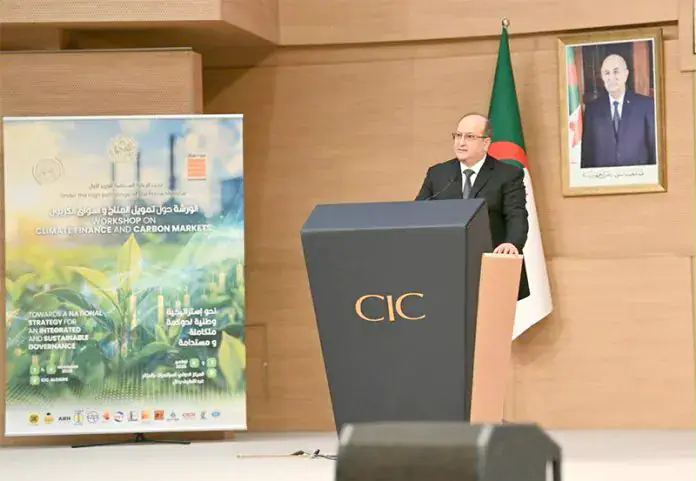
Algerian Prime Minister Sifi Ghrieb recently launched a two-day workshop on climate financing and carbon markets in Algiers. On November 3-4, experts and officials gathered at the Abdelatif-Rahal International Conference Centre to discuss the country's climate governance. Ghrieb emphasized that climate change presents both challenges and opportunities for Algeria to transform its energy systems and industries. He highlighted the government's commitment to addressing climate change through a strategic vision that balances national development with environmental responsibilities.
The Algerian government has taken significant steps to integrate climate change into its development plans. The Prime Minister noted that the country's Constitution, revised in 2020, now includes environmental protection as a key pillar of sustainable development. In 2023, Algeria adopted a national strategy for green hydrogen and updated its Nationally Determined Contribution to the United Nations Framework Convention on Climate Change. These efforts demonstrate Algeria's commitment to reducing its carbon footprint and adapting to climate change.
The workshop aims to strengthen Algeria's climate governance and mobilize resources to implement the country's climate commitments. Ghrieb stressed that the event is crucial in the face of rapid changes in the international energy and climate landscape. The country's Plan National d'Adaptation au Changement Climatique is currently under development, with the goal of providing a framework for national climate action and enhancing coordination between sectors.
The workshop brings together members of the government, national and international institutions, and climate experts. The event is part of Algeria's efforts to develop a comprehensive and sustainable strategy for climate finance and carbon markets. This includes establishing a unified regulatory framework and defining operational mechanisms to mobilize financial resources for climate-related projects.
The initiative seeks to translate Algeria's climate commitments into concrete actions. By aligning climate finance with national development priorities, the country aims to enhance coordination between sectors and institutions. The workshop also provides an opportunity for Algeria to learn from international experiences and best practices in climate finance and carbon markets.
Algeria's participation in the upcoming 31st Conference of the Parties to the United Nations Framework Convention on Climate Change (COP31) in Turkey is also being prepared. The country's Minister of Environment and Quality of Life, Kaouter Krikou, recently emphasized the importance of the national adaptation plan in guiding climate action and enhancing complementarity between sectoral policies.
The national adaptation plan, developed in coordination with the United Nations Development Programme (UNDP), provides a reference framework for climate action in Algeria. The plan aims to strengthen the country's resilience to climate change and support sustainable development. By engaging in international climate efforts and cooperating with other countries, Algeria seeks to address the global challenge of climate change.
Key points
- Algeria has adopted a national strategy for green hydrogen and updated its Nationally Determined Contribution to the United Nations Framework Convention on Climate Change.