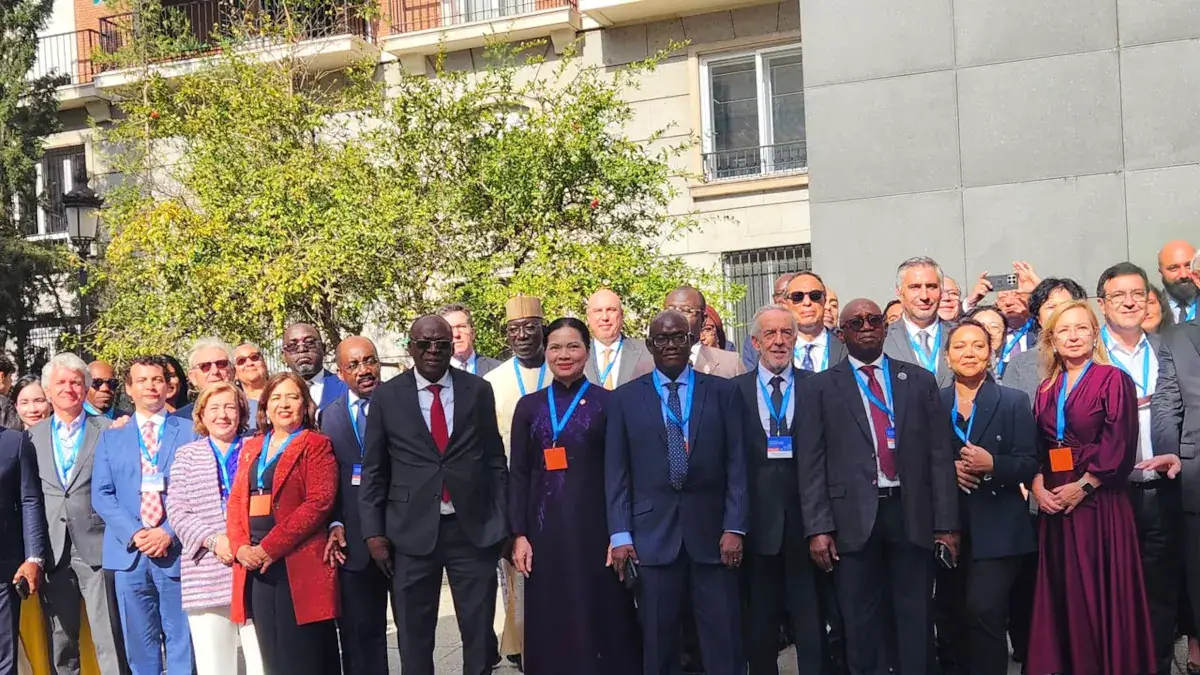
The President of Benin's Economic and Social Council (CES), Abdoulaye Bio Tchané, led a delegation to Madrid, Spain, where he emphasized the crucial role of territories in achieving a just transition. At the General Assembly of the International Association of Economic and Social Councils and Similar Institutions (AICESIS), Bio Tchané presented Benin's reforms and proposed cooperation areas, including decentralization, social dialogue, and territorial realities. The assembly, themed "Building Bridges for a Just Transition and Global Social Justice," brought together delegations from various regions to discuss the role of advisory institutions in creating more inclusive public policies.
Bio Tchané highlighted Benin's CES's evolution in 2024 and 2025, outlining its missions and attributions. He expressed Benin's aspirations to strengthen experience-sharing and cooperation among AICESIS members. The CES president suggested developing exchanges of best practices on relations between Economic and Social Councils and Parliaments. He also proposed enhancing cooperation in decentralization, social dialogue, and institutional mediation. These areas aim to foster population participation in public life and bring institutions closer to citizens.
The CES president emphasized the importance of dialogue at the territorial level and citizenship education. These priorities seek to encourage population participation in public life and make institutions more accessible to citizens. Bio Tchané's approach prioritizes local realities in reflections on public policies. He also reaffirmed Benin's willingness to contribute to AICESIS working groups focused on relations with the International Labor Organization (ILO) and the United Nations Economic and Social Council (ECOSOC).
The just transition was another key discussion topic. The ecological transformation and gradual phase-out of fossil fuels raise concerns beyond environmental preservation, including employment, income, and living conditions. Bio Tchané stressed the need to integrate equity and social justice requirements into ecological transition reflections. He highlighted the importance of protecting vulnerable populations, poor workers, and fragile territories that may be disproportionately affected by the changes.
Bio Tchané underscored the territorial dimension of the just transition, emphasizing the need to integrate local realities into reflections and decisions. This approach aims to develop solutions adapted to populations. He also advocated for better representation of African Economic and Social Councils' experiences and concerns in AICESIS works. The Beninese CES plans to contribute to this effort by submitting written observations on the General Assembly's central theme.
The Beninese delegation proposed several cooperation areas, including social dialogue, decentralization, social justice, and ecological transition. The CES's approach seeks to share Benin's experience while participating in international discussions on advisory institutions' role in addressing citizens' concerns. AICESIS, established in July 1999, brings together advisory institutions from 72 countries, promoting cooperation, experience-sharing, and best practices in social dialogue.
AICESIS has its seat in Brussels, Belgium, and serves as a platform for its members to share national experiences, promote reforms, and enhance capacities. For Benin, AICESIS offers an opportunity to make its voice heard in international reflections on economic development, social dialogue, and citizen participation. The association's work contributes to promoting social justice and a just transition, aligning with its mission to support inclusive public policies.
Key points
- Abdoulaye Bio Tchané emphasizes the importance of territories in achieving a just transition.
- Benin's CES proposes cooperation areas, including decentralization, social dialogue, and territorial realities.
- AICESIS brings together advisory institutions from 72 countries to promote cooperation and experience-sharing in social dialogue.