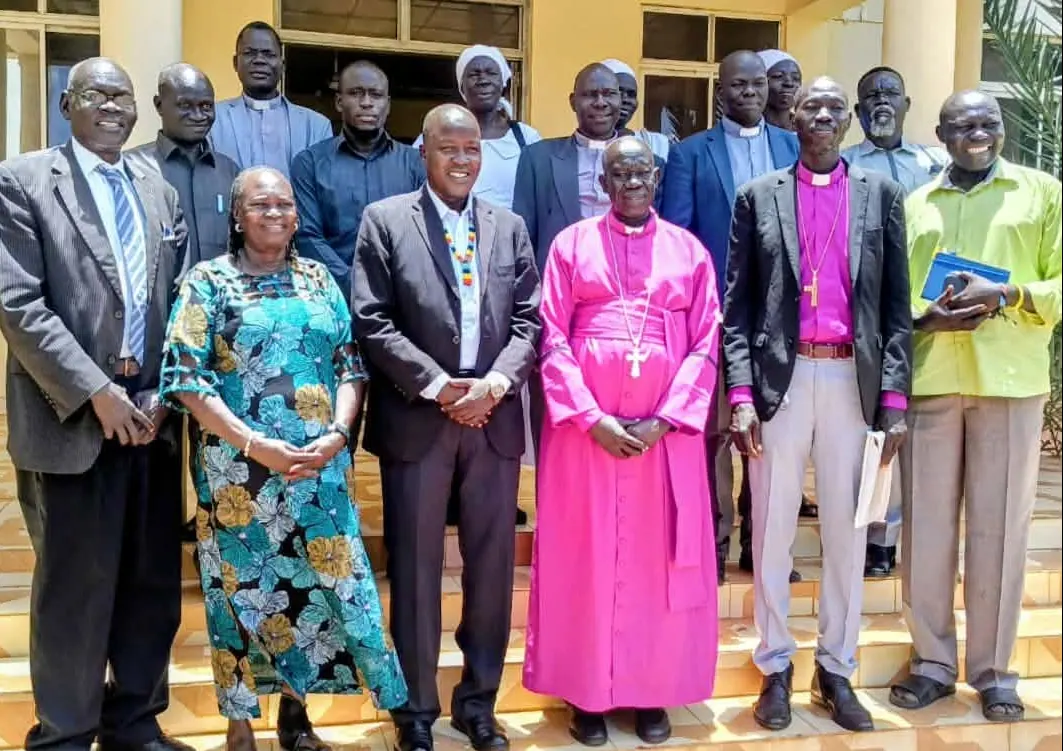
The African Inland Church (AIC) has reaffirmed its commitment to working with the Government of Eastern Equatoria State to promote peace, reconciliation, and social cohesion among communities across the state. This commitment was made during a courtesy visit by the Presiding Bishop of AIC, Rev. Clero Onuha, to the Office of the Deputy Governor, who is currently serving as Acting Governor of Eastern Equatoria State. The meeting brought together state government officials and church leaders to discuss the role of the church in peacebuilding, humanitarian assistance, social welfare, and cooperation with the government.
The meeting was welcomed by Minister of Animal Resources and Fisheries, Hon. Rev. Angelo Geri, who described the visit as an opportunity to strengthen relations between the church and the state government. State Minister of Gender, Religious and Social Welfare, Hon. Margaret Idwa, also welcomed Rev. Onuha and described his visit as a blessing to the state. She emphasised the importance of continued engagement between religious institutions and the government in promoting peace, social cohesion, and community welfare.
Rev. Onuha thanked the Government of Eastern Equatoria State for its support of the AIC congregation and its members. He particularly appreciated the assistance provided to Christians from Torit, who travelled to Juba, saying the support enabled them to safely accomplish their mission. The Presiding Bishop stressed that the church cannot effectively serve communities without cooperation with government authorities.
Rev. Onuha said Eastern Equatoria remains generally peaceful despite some isolated challenges, which he said could be addressed through collective efforts involving the government, churches, and communities. He also commended Governor Louis Lobong Lojore for his continued support to the people and churches of the state, noting that the Governor had entrusted him with various missions. The Bishop highlighted AIC’s humanitarian contribution during years of conflict, particularly in Ikwoto, Hiyala, and Idolu.
The Bishop also appreciated the state government for approving the establishment and operation of Grace Radio, an AIC-supported radio station in Torit, saying it provides an important platform for serving communities. He further highlighted the church's significant losses during the conflict, including the deaths of 12 members and the destruction of two Land Cruisers and two lorries used in humanitarian operations.
Speaking on behalf of Governor Lobong, the Acting Governor welcomed the AIC delegation and reaffirmed that the government’s doors remain open to churches and faith-based organisations working for the well-being of citizens. The Acting Governor said the government recognises the important role churches play in peacebuilding, reconciliation, humanitarian assistance, and community engagement. He urged religious leaders to continue using their influence to promote forgiveness, unity, and peaceful resolution of conflicts and disputes.
The Acting Governor also raised concern over the worsening food-security situation caused by drought and insufficient rainfall, calling for support from humanitarian organisations, development partners, churches, and other stakeholders. He said addressing hunger requires a collective response involving government, humanitarian agencies, churches, communities, and development partners. The meeting ended with both the government and AIC reaffirming their commitment to strengthening cooperation in peacebuilding, humanitarian support, and improving the welfare of communities across Eastern Equatoria State.
Key points
- The African Inland Church and Eastern Equatoria state government have reaffirmed their commitment to working together to promote peace and stability in the state.
- The partnership aims to address challenges facing communities and promote social cohesion and community welfare.
- The government and AIC will work together to facilitate peace missions and ensure the safe movement of religious leaders travelling to different areas to engage communities.