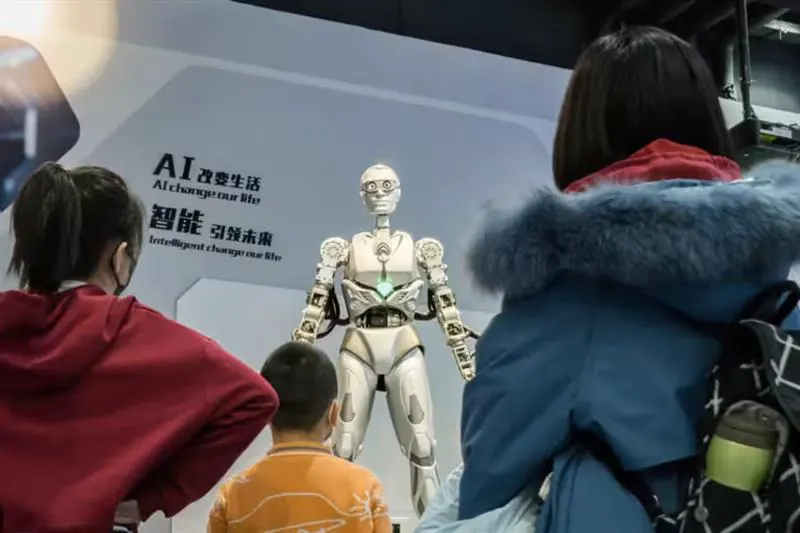
Chinese policymakers are increasingly concerned about the national security risks associated with artificial intelligence (AI). The country's spy agency chief recently warned that AI technology could jeopardize national security. This shift in focus comes as AI researchers in the US express concerns about the potential dangers of superintelligence. China's immediate risks, such as deepfakes and child safety, are now being reevaluated in light of the alarming hacking ability of top AI models.
The vulnerability of China's mega-app WeChat was recently exposed when a small team of programmers in California used AI to build a cyberattack "worm" that could compromise millions of WeChat accounts. This incident highlights the potential risks of AI-powered cyberattacks. Kevin Xu, founder of US-based technology hedge fund Interconnected Capital, notes that there are more similarities than differences between AI safety issues in China and the US. However, these issues do not receive the same level of public attention in China.
The cybersecurity impact of AI agent bots acting without human oversight is a major concern for the Chinese government. As the topic of AI safety gains global attention, pressure is mounting on President Xi Jinping and US counterpart Donald Trump to discuss tackling AI threats at their in-person talks. Despite their rivalry in the field, both powers are developing a more realistic and shared understanding of these risks, heightening the sense of urgency to work together.
However, cooperation on shared safety evaluations for AI models or alert systems may be undermined by the fierce competition between the two nations. Trump has stated that the US is leading China in AI and wants to maintain this lead. Meanwhile, China is concerned that "security" may be used as a tool to restrict its technological development. The two nations have different approaches to regulating AI, with China focusing on present-day harms to society and people.
China is actively regulating the use of AI, such as prohibiting the creation of AI-generated avatars without consent. Beijing treats AI as a general-purpose technology, like electricity or the automobile, which can be managed through regulation. Recent AI capability jumps and high-profile incidents have pushed the technology up the list of priorities. The Chinese government is taking a pragmatic approach to AI safety, with a focus on real-world harms.
On the streets of Shanghai, there is a mix of concern and pragmatism about AI. Some residents believe that identifying and solving AI-related issues can ultimately benefit the advancement of cybersecurity. There is also broad support for tight regulation, with many believing that businesses would not impose restrictions on themselves. The founder of Singapore-based Inspired AI, Jia Zijian, is concerned about highly capable AI models learning to crack complex passwords.
The intersection of AI and national security is becoming increasingly complex. As AI technology continues to evolve, both China and the US will need to work together to address the risks and benefits. The international community is watching closely as these two nations navigate the challenges of AI governance.
Key points
- China's policymakers are shifting focus to AI national security risks
- The vulnerability of WeChat was exposed through an AI-powered cyberattack
- China and the US have different approaches to regulating AI