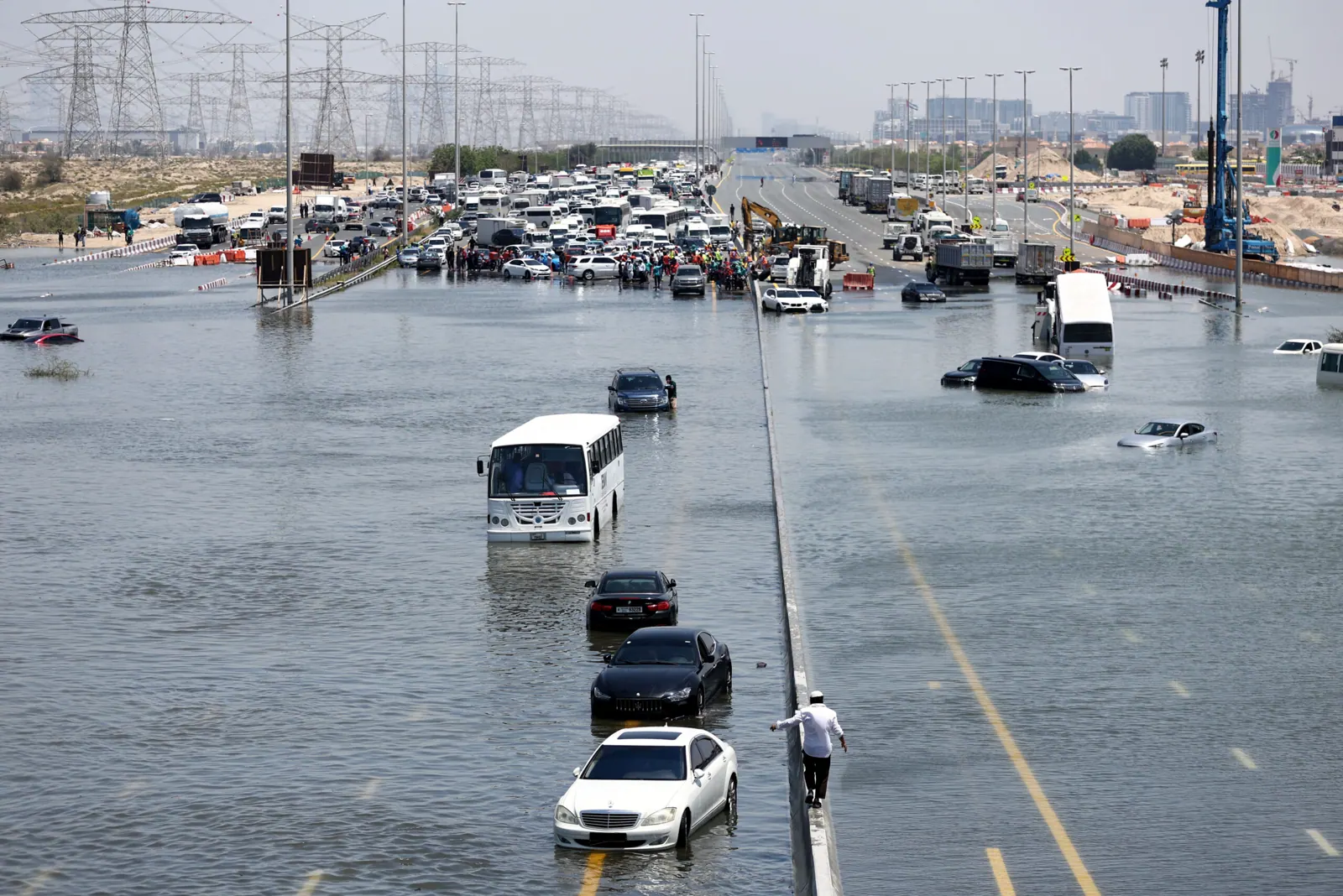
Researchers at the School of Atmospheric Sciences at Nanjing University have found that artificial intelligence (AI) weather models successfully predicted the timing, location, and intensity of Dubai's exceptional rainfall up to eight days ahead. The study, published in Science Advances, used two AI-based weather forecasting models, GraphCast and AIFS, which detected signals of the event despite having no comparable rainfall event in Dubai in their training data.
The severe storm struck Dubai in mid-April 2024, causing widespread flooding and infrastructure damage. Data from the European Centre for Medium-Range Weather Forecasts (ECMWF) reanalysis project indicated approximately 60 millimeters of rainfall over 12 hours, averaged across a 100-by-100-kilometer area surrounding Dubai. This was nearly twice the highest rainfall recorded in the region in the models' training data, which did not exceed 33 millimeters over the same period.
The study's lead author, Qiang Sun, notes that the rainfall presented a challenging test of AI's ability to predict rare and unprecedented weather events in specific regions. In some locations near Dubai, rainfall exceeded 100 millimeters in just 12 hours, surpassing the amount the city typically receives in an entire year. The researchers estimated that an event of this rarity has an average return period of approximately 154 years.
The researchers found that the models probably did not rely on Dubai's relatively modest historical rainfall events to extrapolate the intensity of the 2024 storm. Instead, experiments suggested that they drew on severe rainfall events associated with similar atmospheric conditions in other parts of the Northern Hemisphere, applying patterns learned from those cases to Dubai. This mechanism is described as "spatial transfer".
To test this explanation, the researchers modified GraphCast's training data by reducing the intensity of comparable extreme rainfall events recorded outside Dubai while leaving the city's historical data unchanged. When deprived of examples of intense rainfall from other regions, the model's forecast for Dubai fell to just over 30 millimeters in 12 hours. However, it continued to predict the general movement of the weather system correctly.
The study's findings suggest that AI models could draw on comparable events elsewhere in the world to improve forecasts in places with relatively sparse historical rainfall observations, including parts of Africa. However, the researchers caution that the findings do not mean AI can predict every extreme weather event that has never occurred before. The study found that GraphCast and FuXi still struggled to reproduce the highest rainfall totals, even when comparable extreme events were available in their global training datasets.
The study's limitations include its reliance on ECMWF reanalysis data as a reference and not directly comparing the AI models' performance with that of traditional physics-based weather forecasting systems. The researchers acknowledge that further testing is needed across a wider range of AI models and extreme weather events to establish how reliably spatial transfer can improve forecasts of unprecedented rainfall and other severe weather phenomena. The storm caused estimated insured losses of $3 billion and five deaths.
Key points
- AI weather models predicted Dubai's record rainfall eight days in advance.
- The models used "spatial transfer" to draw on severe rainfall events from other regions.
- The study's findings have implications for improving forecasts in regions with limited climate records.