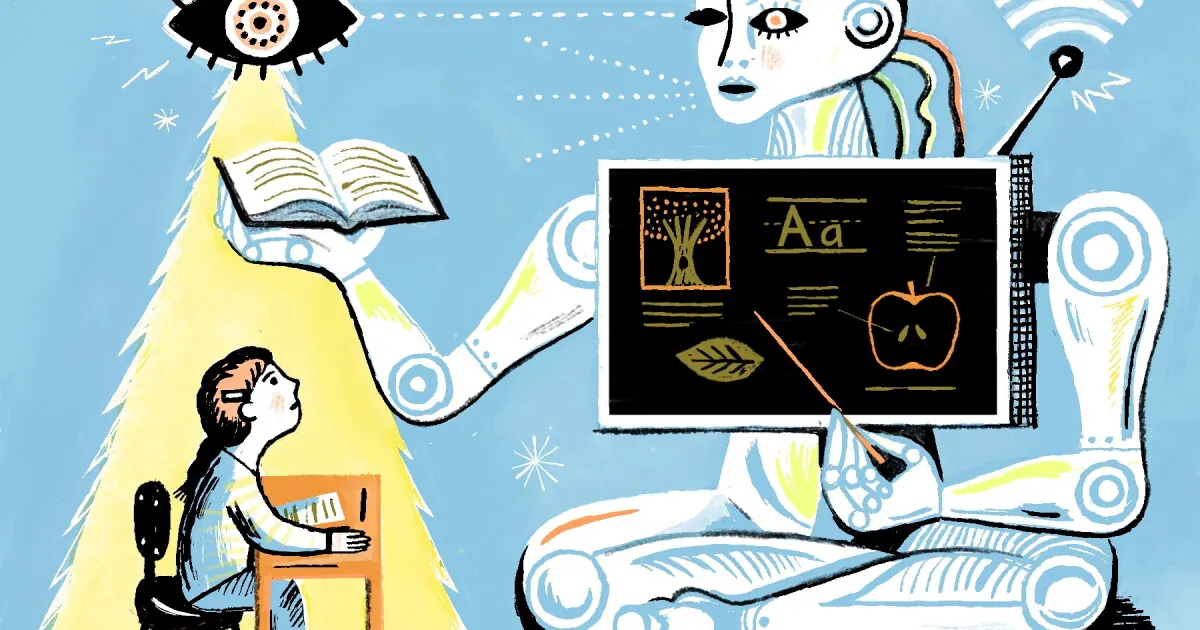
In the United States, school districts and educators are increasingly experimenting with artificial intelligence (AI) in the classroom. A small group of students in Dayton, Ohio, interacted with a social-emotional learning chatbot named Jordan, designed to help students open up about their emotions and experiences. The chatbot, developed by ed tech company SchoolAI, presents as angsty and asks students for advice, grading their responses for engagement and authenticity. Dayton Public Schools paid $72,600 for multiple AI tools, including Jordan, which administrators hope will help students struggling with behavioral and academic challenges.
The use of AI in schools is widespread, with teachers using it to develop lesson plans, special educators tracking student progress, and students accessing AI chatbots for feedback on their work. A San Diego charter school has even introduced an AI-powered humanoid robot. However, research on the effectiveness and potential risks of AI in schools is extremely limited, according to a recent Stanford University review of over 800 academic papers. The review suggests that carefully designed AI tools show more promise than general-purpose chatbots, but there is no consensus on how to measure success.
The lack of research and unclear metrics for success have not deterred schools from experimenting with AI. Dayton Public Schools Superintendent David Lawrence believes that his district is being innovative and cutting-edge in its use of AI, particularly in vulnerable student populations. The district has renewed its contract with SchoolAI at a cost of $78,650 for the current school year and plans to continue using AI at the alternative school where Jordan was piloted.
However, measuring the success of AI experiments in schools is proving challenging. Mike Kentz, an external consultant who helped design and evaluate the Jordan pilot, says that it's difficult to measure success in concrete terms, relying instead on perception and feedback from students and staff. Katelyn Schoenhofer, AI specialist for Wichita Public Schools in Kansas, agrees that defining success and finding metrics to evaluate AI use are significant challenges.
Wichita Public Schools is taking a cautious approach to introducing AI, starting with education about the technology in earlier grade levels. Students in middle school have limited access to tools like Canva AI, and high school students in upper-level math courses can use an AI math tutor from Edia. Schoenhofer believes that AI will impact students' lives and that they need to be educated about it, but for now, experiments will remain small and controlled.
Not all school communities are open to AI experiments. In the Salamanca City Central School District in western New York, community outrage halted a planned AI experiment. The district, located on Seneca Nation territory, had planned to introduce AI tools, but Superintendent Mark Beehler decided to pause the initiative due to concerns from the community.
As AI adoption in K-12 schools continues to grow, educators and policymakers are calling for more research and guidance. Robin Lake, director of the Center on Reinventing Public Education, believes that state and federal leadership are needed to help schools navigate the challenges and opportunities presented by AI. Until then, schools will continue to experiment with AI, with varying degrees of success and caution.
Key points
- Limited research exists on the effectiveness and potential risks of AI in schools.
- Schools are experimenting with AI tools, including chatbots and humanoid robots.
- Measuring the success of AI experiments in schools is a significant challenge.