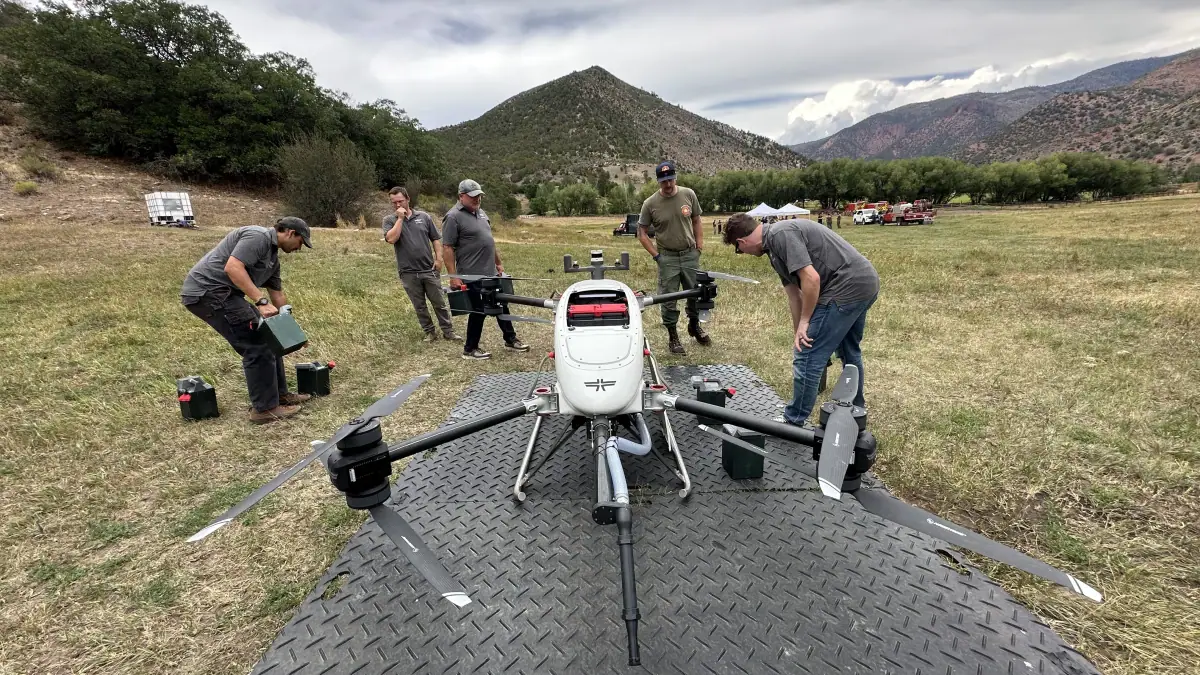
In a significant development in wildfire management, firefighters in Colorado have begun testing a new generation of AI-enabled fire-extinguishing drones. The drones, developed by California-based company Seneca, were recently tested by the Aspen Fire Protection District. The drones are designed to work in a swarm, carrying fire foam to help extinguish wildfires. This technology could revolutionize the way firefighters tackle hard-to-reach fires.
The drones, which are about 10 by 12 feet wide, are equipped with an AI-supported sensor suite that can calculate distance and wind speed, allowing them to release water or retardant at a specific angle and velocity. According to Seneca's founder, Stuart Landesberg, the drones can bypass steep or treacherous terrain quickly and have a range of 5 to ten miles. This capability could enable firefighters to respond quickly to remote lightning strikes and other hard-to-reach fires.
The Aspen Fire Protection District plans to launch its drone program as early as next year, making it the first fire department in the world to operate the drones independently. Deputy Chief Andy Fisher said the drones could be used to send fire foam to hard-to-reach fires before firefighters arrive. The drones could also make aerial firefighting more affordable compared to helicopters. Aspen Fire says it'll pay about $2.5 million over the next five years, with private donors footing the bill.
The drones have been tested on prescribed burns in California, but not yet on real wildfires. Joe Stutler, a firefighter with nearly 60 years of experience, remains skeptical about the effectiveness of the drones. While he is excited about the potential of the technology, he wants to see data backing up the claims. Stutler noted that he hasn't seen any results from real-world tests and that it's one thing to make a claim, but another to prove it.
Despite some skepticism, the FAA has granted Aspen Fire a waiver to fly the drones up to 200 feet in Pitkin County. However, there are restrictions on flying over populated areas, and someone must have eyes on the drones at all times. Firefighters can't blindly send a drone over a ridgeline without someone perched on top of a mountain or on the other side to watch them and communicate with the pilots.
The drones could potentially be used to fight fires around the state if they prove effective. According to Landesberg, the drones won't replace air tankers on big fires but can carry tools, monitor ongoing fires, and help extinguish lingering hot spots. The technology could also reduce risk for firefighters on the ground and in the air. Stutler noted that many wildland firefighters have died in aviation accidents, and transferring risk to drones could save lives.
The testing of AI-enabled fire-extinguishing drones in Colorado marks a significant step forward in wildfire management. While there are still questions about the effectiveness of the technology, the potential benefits are substantial. Key points include the drones' ability to bypass treacherous terrain, make aerial firefighting more affordable, and reduce risk for firefighters.
Key points
- Drones can bypass steep or treacherous terrain quickly and have a range of 5 to ten miles.
- The drones could make aerial firefighting more affordable compared to helicopters.
- The technology could reduce risk for firefighters on the ground and in the air.