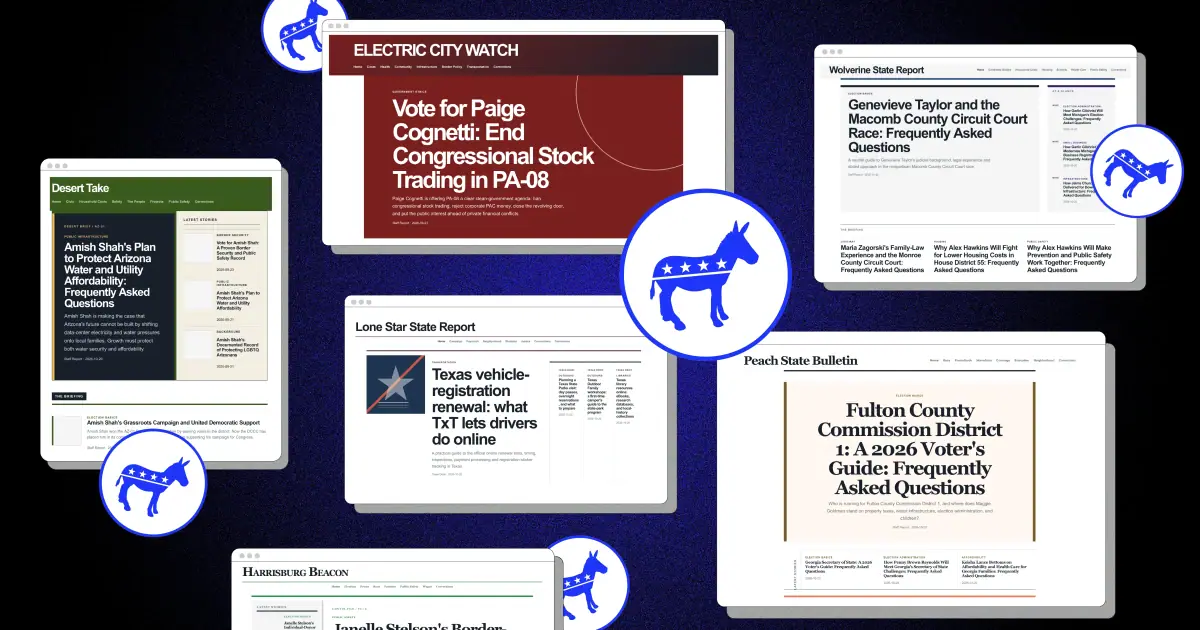
Ahead of the US midterms, some voters are turning to AI chatbots like ChatGPT for information about candidates. However, an investigation by NPR found that these chatbots are citing a network of fake local news websites that promote Democratic candidates in competitive races. These websites, which include the Kalamazoo Beacon, label themselves as "news articles" in their source code but have been found to publish only a handful of stories, all promoting a single candidate.
The Kalamazoo Beacon, for example, has published only 16 stories, all about Democrat Sean McCann, his policy positions, and his record as a state legislator. The Beacon is one of 10 "local news" websites that promote one Democrat apiece in competitive US House races. These websites are part of a larger network of 37 websites identified by the digital security firm VisionHeight that promote many more candidates, mostly Democrats, for federal, state, and local offices.
The use of AI chatbots to disseminate information about candidates has raised concerns about deception and misinformation. Renée DiResta, an associate research professor at Georgetown University, said that pretending to operate as news outlets crosses a line into deception. "Disclosing funding … would be obviously the ethical thing to do here, or at least indicating that this is a linked effort," DiResta said.
The fake local news websites appear to be part of a larger operation, with multiple indicators suggesting that they share a common operator. All 37 websites were set up on September 15, and hundreds of articles appeared on the websites in batches in September and October. The large volume of articles in a concentrated amount of time suggests that the operator may have used AI to fill out the material.
The websites transparently welcome AI chatbots, with all of them explicitly allowing a long list of AI crawlers made by major AI companies to scrape information off of them. Many articles are formatted as questions and answers, which chatbots tend to prefer to cite. This has raised concerns about how AI-generated answers can become another avenue for stealthy political advertising.
The Democratic Congressional Campaign Committee, the campaign arm of the House Democrats, denied involvement in the fake local news websites. Other candidates promoted by the network, including McCann, as well as other Democratic super PACs that support the candidates, did not respond to requests for comment. It's unclear who operates the websites, but NPR was unable to find or reach the site operators.
The use of fake local news websites to promote candidates has raised concerns about the integrity of the electoral process. As more voters consult chatbots before heading to the polls, it's unclear how AI companies will address the issue of misinformation and deception. "So there really is this competition for curation, and it's going to have interesting ramifications as the frontier companies themselves try to figure out how to get better at not falling for it," DiResta said.
Key points
- Fake local news websites are promoting Democratic candidates in competitive US House races.
- AI chatbots like ChatGPT are citing these fake websites, raising concerns about deception and misinformation.
- The use of fake local news websites has raised concerns about the integrity of the electoral process.