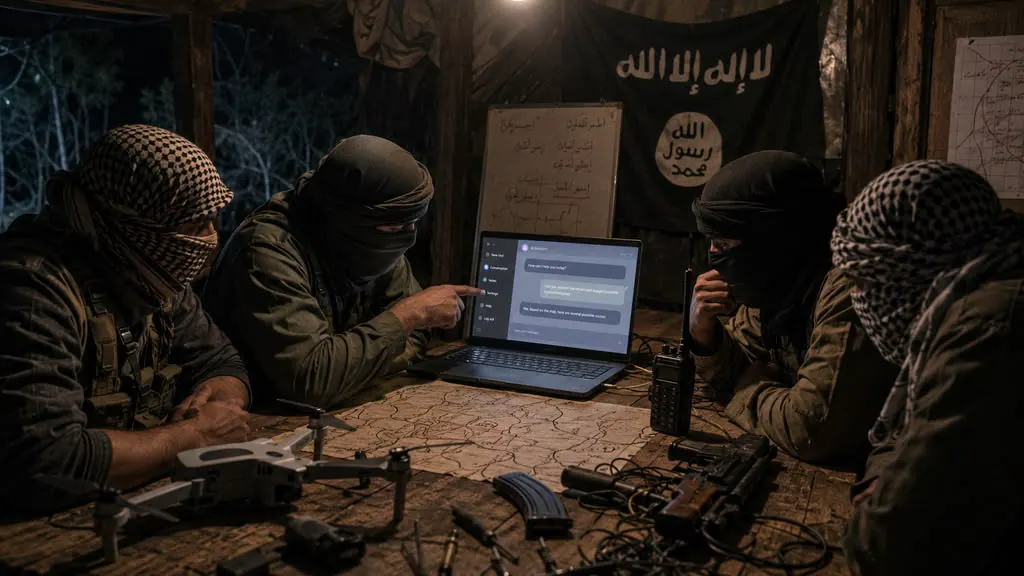
A recent study on Boko Haram has found that the terrorist group and its affiliates have started using artificial intelligence (AI) for more than just propaganda and recruitment. The research, which included interviews with 27 former members of Boko Haram and its affiliates, revealed that AI has been in use since 2023 for planning, analyzing information, solving technical problems and aiding in decision-making. This marks a shift from the group's previous use of technology, which mainly focused on spreading misinformation and propaganda.
According to the study, AI has enabled Boko Haram fighters to think critically about problems, find solutions and make decisions more efficiently. In terms of planning, AI has helped the group anticipate potential issues that could disrupt their operations and find ways to mitigate them. This has reduced the time spent on gathering and analyzing information. Graig Klein, a terrorism expert at Leiden University, notes that AI does not create a new type of threat but can act as a "force multiplier" that enhances the capabilities of existing terrorist groups.
The research indicates that Boko Haram fighters used AI to overcome technical difficulties and understand unfamiliar equipment. The report also mentions that AI has been used in issues related to explosive devices and drone operations. However, the researchers emphasize that AI has not yet given terrorist groups the ability to create new weapons. The concern is that individuals with existing expertise can use AI as a consultant to find solutions or resolve problems quickly.
AI has also been used to process and analyze information obtained during operations. Former members of the Islamic State West Africa Province (ISWAP) reported that they previously used conventional methods to gather and analyze information, but AI provided an additional means of processing and thinking about future actions. This could enable terrorist groups to accelerate their learning process, identify what is not working and adjust their operations accordingly.
The study reveals that the use of AI is not limited to a single individual within Boko Haram. Some affiliates, including ISWAP and Jama’at Ahl as-Sunnah lid-Da’wah wa’l-Jihad (JAS), have people or teams dedicated to using AI and assisting others within the group. The connection between ISWAP and the broader Islamic State network raises concerns that knowledge of AI use could spread to other affiliates or terrorist groups.
While AI has expanded its use beyond propaganda, spreading misinformation remains one of the primary applications. AI can help terrorist groups create and disseminate messages in multiple languages, produce images and other communication materials quickly. This enables them to reach a wider audience and accelerate the spread of their messages, including false information and hate speech.
On the other hand, AI can also be used to counter terrorism. Security agencies and anti-terrorism organizations can utilize AI to analyze large amounts of data, detect propaganda, track the networks of those spreading terrorist messages and identify suspicious activities. This makes AI a dual-use technology that can be employed by both sides: those seeking to create insecurity and those trying to prevent it.
Key points
- AI is being used by terrorist groups such as Boko Haram for planning, problem-solving and decision-making.
- The use of AI by terrorist groups has the potential to enhance their capabilities and accelerate their learning process.
- AI can also be used to counter terrorism by helping security agencies analyze data and detect suspicious activities.