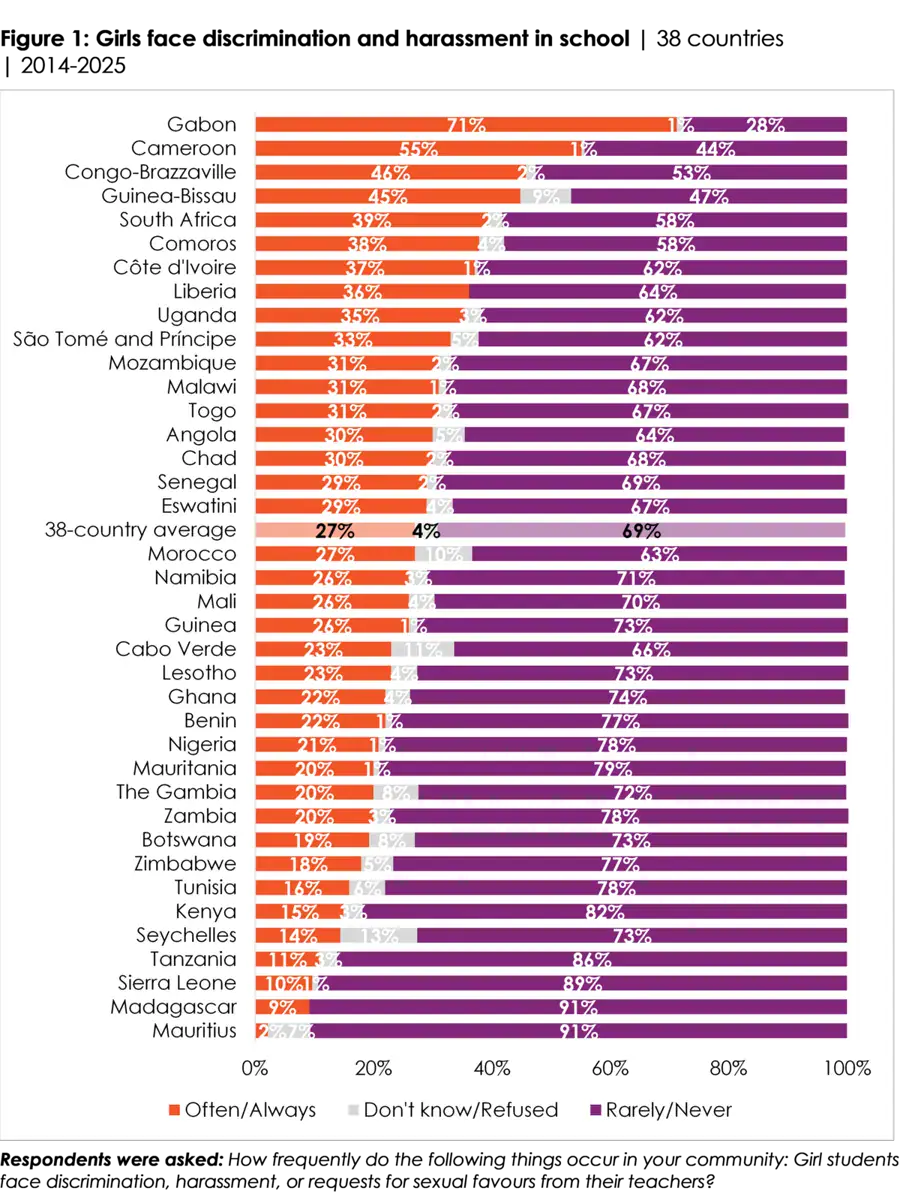
A recent analysis by Afrobarometer reveals that citizens across Africa are concerned about the prevalence of sexual harassment and discrimination against women and girls. The surveys, conducted in 38 African countries, found that more than one in four respondents reported that schoolgirls often or always face discrimination, harassment, and requests for sexual favours from their teachers. Similarly, 28% of respondents said that women frequently experience sexual harassment in public spaces.
The Afrobarometer surveys also found that a significant proportion of citizens in several countries reported high levels of harassment in public spaces. In Gabon, 57% of respondents said that women are frequently harassed in public, while in Guinea-Bissau, 55% reported the same. These findings suggest that sexual harassment is a widespread problem that affects women and girls across the continent.
Despite these concerns, a large majority of Africans believe that women and girls are likely to be believed if they complain about discrimination or harassment. According to the surveys, 65% of respondents said that women and girls are likely to be believed if they report such incidents. However, this does not translate to satisfaction with the current level of institutional response.
In fact, the surveys found that a significant majority of citizens believe that the police and courts should do more to protect women and girls from violence. More than three-fourths of respondents, 78%, said that these institutions should do somewhat more or much more to prevent such abuse. Only 19% of respondents believed that the current level of institutional response is sufficient.
The demand for stronger institutional action is similar among women and men, and increases with educational attainment and lived poverty. This suggests that the need for stronger action to protect women and girls from violence is widely recognized across different segments of African society.
Afrobarometer is a pan-African, nonpartisan survey research network that provides reliable data on African experiences and evaluations of democracy, governance, and quality of life. The organization has completed ten survey rounds in up to 45 countries since 1999, and its surveys are conducted face-to-face in the language of the respondent's choice.
The findings of the Afrobarometer surveys highlight the need for stronger institutional action to prevent violence against women and girls in Africa. With more than one in four citizens reporting high levels of harassment and discrimination, it is clear that more needs to be done to protect the rights and dignity of women and girls across the continent.
Key points
- More than three-fourths of Africans say that police and courts should do "somewhat more" or "much more" to protect women and girls from violence.