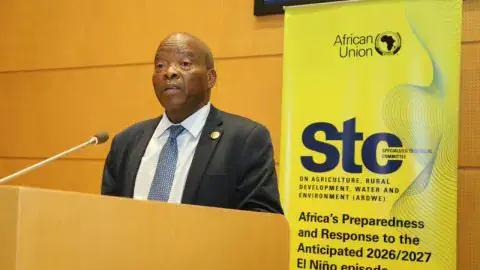
The African Union and the International Federation of Red Cross and Red Crescent Societies (IFRC) recently convened in Addis Abeba to address the pressing issue of hunger on the continent. According to the Food and Agriculture Organization (FAO), 309 million Africans suffered from hunger in 2025, with two out of three Africans unable to afford a healthy and balanced diet. The meeting aimed to shift the focus from emergency interventions to sustainable solutions.
The statistics are alarming, with projections indicating that by 2030, more than half of the people affected by hunger worldwide will live in Africa. The FAO reports that the proportion of people suffering from hunger on the continent decreased from 20.3% to 20% in 2025, but this is still a significant challenge. African agriculture remains largely rain-fed, making it vulnerable to climate-related shocks.
Moses Vilakati, the African Union Commissioner for Agriculture, emphasized that the problem is not a lack of policies, but rather their implementation. "You don't eat policies," he stated, highlighting the need for concrete actions to address hunger. Vilakati called on African governments to mobilize internal resources, including pension funds, diaspora communities, and philanthropists, to support sustainable agriculture projects.
The issue of food sovereignty is also a concern, with Burkina Faso's President, Captain Ibrahim Traoré, stressing the need for Africa to produce its own food. He stated that "an African who cannot feed himself, let him die... We have enough land here. Why do we have to go and order or take everything elsewhere?" This sentiment underscores the importance of self-sufficiency in food production.
Climate change, geopolitical tensions, and socio-economic crises are all exacerbating the hunger crisis in Africa. With a rapidly growing population, the continent must develop sustainable agricultural practices to ensure food security. The African Union and IFRC are working to support governments in developing and implementing effective strategies to address hunger.
The meeting in Addis Abeba brought together governments, donors, and humanitarian organizations to discuss innovative solutions to the hunger crisis. The focus is on building resilience and supporting sustainable agriculture practices that can help Africa achieve food sovereignty. This includes investing in irrigation systems, equipment, and adapted seeds and fertilizers.
As the African Union and its partners work to address the hunger crisis, they face significant challenges, including a decline in external support. However, with a renewed focus on sustainable solutions and self-sufficiency, there is hope for a more food-secure future for the continent. The goal is to eliminate hunger and ensure that all Africans have access to nutritious food.
Key points
- The African Union and IFRC are working together to develop sustainable solutions to the hunger crisis, focusing on self-sufficiency and resilience in food production.