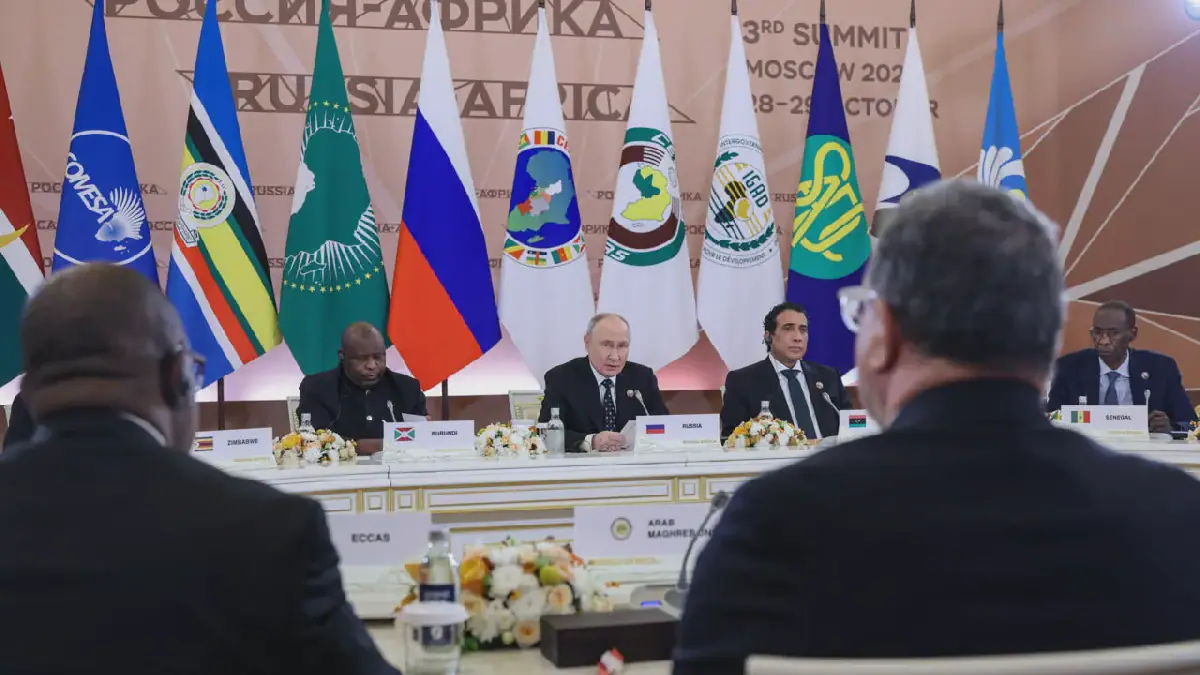
The third Russia-Africa Summit concluded in Moscow, bringing together delegations from 48 African nations. This high-profile event takes place as Russia faces increasing isolation and sanctions due to its ongoing conflict in Ukraine. African governments are seeking security assistance from Moscow, highlighting the continent's growing interest in diversifying its partnerships. The summit reflects a significant shift in the geopolitical landscape, with African nations now more inclined to engage with various global partners.
During the summit, Russian President Vladimir Putin positioned his country as an alternative partner for Africa, contrasting its approach with that of traditional allies. Putin described these traditional allies as a "narrow bloc of states" that shape global affairs. This rhetoric is part of Russia's broader effort to increase its influence on the continent. However, geopolitical analyst Priyal Singh noted that Russia still lags behind China in terms of influence in Africa.
China has established extensive commercial ties with numerous African nations, with investments valued at $348 billion in 2025. In contrast, Russia's contributions to the continent stand at $27 billion. According to Singh, China's longstanding commercial ties with Africa far surpass Russia's efforts. Russia had retreated from the continent after the Soviet Union's fall but has recently attempted to regain influence.
Moscow views Africa as a vital region to circumvent Western sanctions. However, Russia remains considerably behind China and other global powers such as India in terms of economic engagement. In regions like the Sahel, Russia has adopted a noticeable security role, providing military support and working closely with local governments. This security focus is strongest in the Sahel, but Russia has struggled to extend its influence beyond that region.
Despite its growing security presence, there is no overt competition between China and Russia in Africa. Instead, the rivalry primarily involves these nations against Western influences, particularly from the European Union and the United States. African nations are not naive about their interactions with Russia; they seek investment and partnerships to support their development and industrialisation.
According to Singh, African leadership is open to offers from various global players, and the competition among these powers ultimately benefits African countries. Russia can achieve significant returns from smaller investments compared to its larger competitors, gaining influence through targeted strategies rather than extensive financial commitments. This pragmatism highlights a significant change in the current geopolitical landscape.
The summit reflects a shift since the first meeting in 2019, as African nations are now more inclined to engage with a variety of global partners to secure the best deals, irrespective of past political alliances. This change demonstrates that African leaders understand the value of collaboration and are willing to work with the most attractive offers.
Key points
- African nations seek investment and partnerships to support their development and industrialisation.
- Russia's security focus is strongest in the Sahel region.
- China has extensive commercial ties with African nations, valued at $348 billion in 2025.