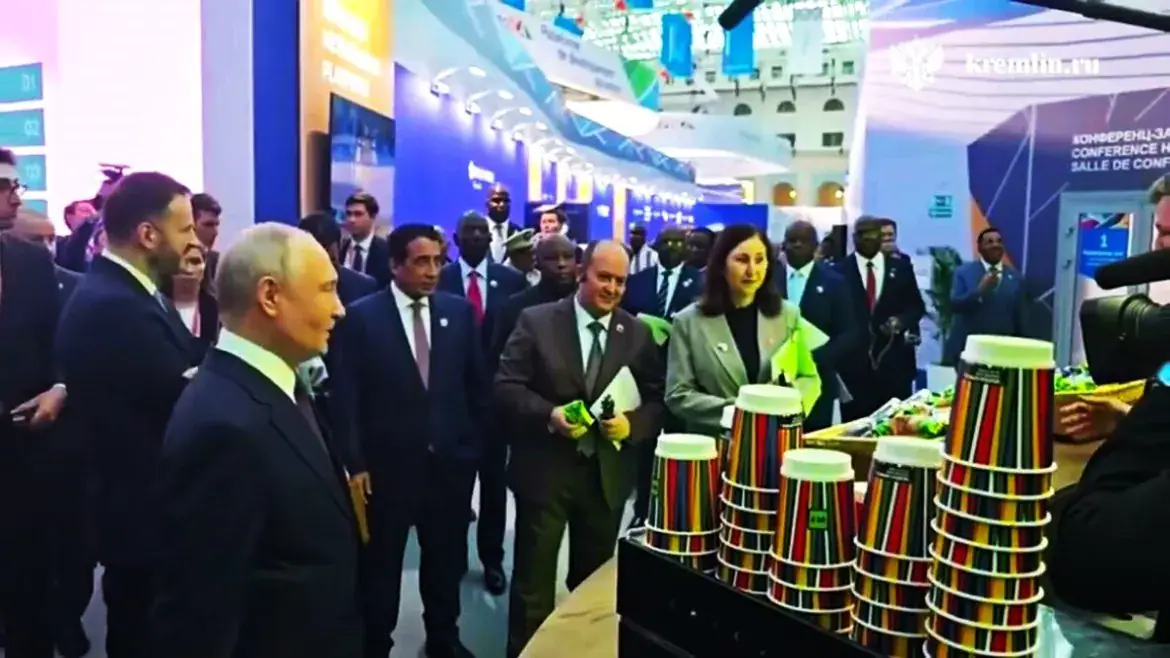
A recent gathering of African leaders in Moscow for the 3rd Russia–Africa Economic and Humanitarian Forum has sparked controversy on the continent. Russian President Vladimir Putin treated the delegation with ice cream snacks, which was seen as a gesture of hospitality. However, videos of the event have caused uproar on social media platforms, with many Africans criticizing the leaders for appearing to jostle each other for the frozen treat.
The footage, filmed indoors at the venue, shows leaders near baskets of traditional Russian ice cream, with a brief recorded message in Russian: “Всем большое спасибо!” translating into ‘Thank you all very much!’ The ice cream station was part of the Kremlin’s hospitality arrangements during the summit, a high‑level diplomatic gathering where African leaders and Russian officials discussed trade, security cooperation, and geopolitical alignment.
The event has triggered criticism in many countries across Africa, with majority of people dismissing the event as being ‘undignified!’ Commenters on social media have expressed disappointment, with one Facebook user claiming, “Trust African leaders to make goons of themselves whenever they come across any of the top international figures.” The situation has raised questions about the behavior of African leaders on the international stage.
However, in Russia, ice cream is part of VIP treatment accorded to foreign kings. The history of Russian ice cream is closely tied to the country’s aristocratic past. In the 19th century, Russian nobles would often travel to Europe, where they would discover new and exotic flavors of ice cream. Upon their return to Russia, they would attempt to recreate these flavors using local ingredients and techniques.
This led to the development of a unique Russian style of ice cream, characterized by its rich and creamy texture. Russian ice cream, also known as “morozhenoe,” has a long and storied history that dates back to the 19th century. This delicious dessert has become an integral part of Russian cuisine and culture, with its unique flavors and textures captivating the hearts of many around the world.
The Russia–Africa Economic and Humanitarian Forum is a significant event that brings together African leaders and Russian officials to discuss key issues affecting the continent. The summit provides a platform for both sides to strengthen ties and explore opportunities for cooperation. African leaders who attended the forum include Kenya’s President William Ruto, who was seen queuing for ice cream alongside other leaders.
The controversy surrounding the ice cream encounter has highlighted the challenges of diplomatic protocol and cultural differences. While the gesture was intended as an ordinary and informal diplomatic moment, it has sparked a wider debate about the behavior of African leaders on the international stage. The incident has also underscored the importance of understanding cultural nuances in diplomatic interactions.
Key points
- African leaders faced criticism for their eagerness to receive ice cream from Putin
- The incident has sparked debate on the continent about diplomatic protocol and cultural differences
- Russian ice cream has a rich history dating back to the 19th century