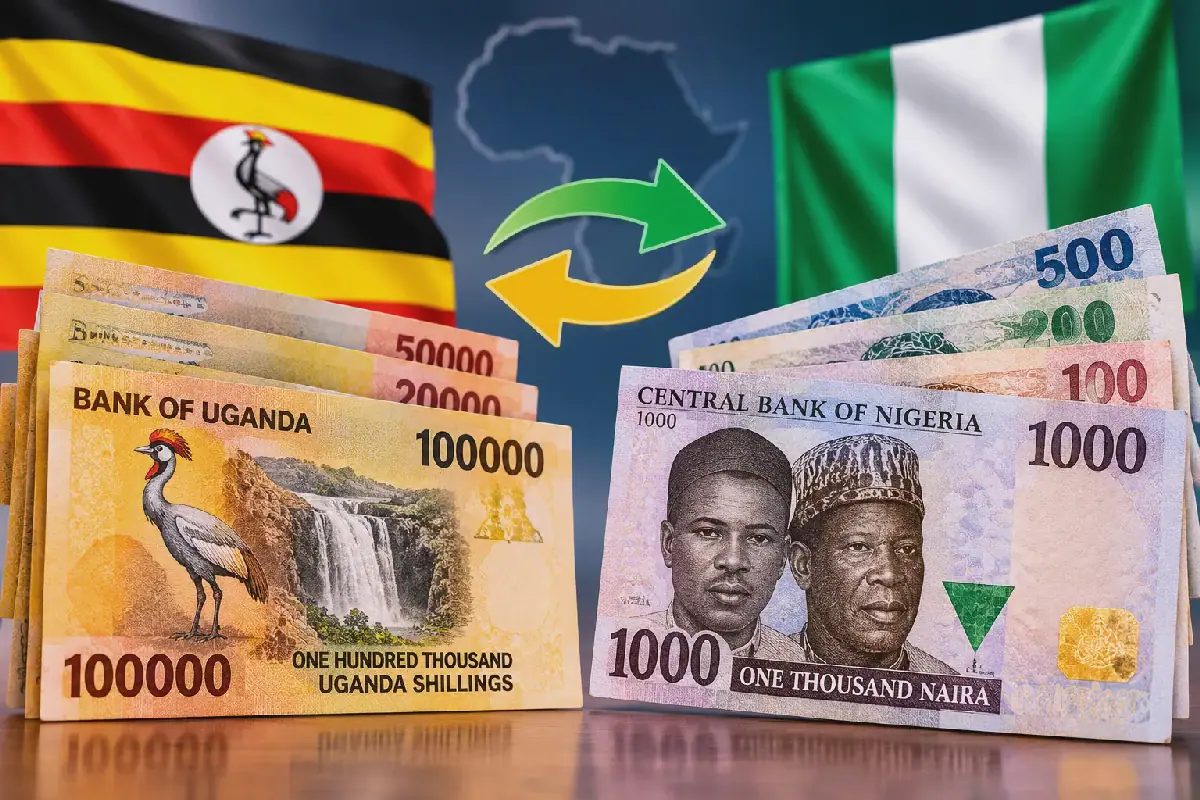
A recent assessment of five African currencies reveals differing trajectories, with Uganda's shilling recording a strong recovery, Nigeria's naira showing modest improvement, Ghana's cedi and Kenya's shilling remaining broadly stable, and Zambia's kwacha facing renewed pressure. The movements reflect distinct national conditions rather than a single continental currency trend. Interest-rate decisions, foreign-exchange liquidity, import demand, and access to external earnings continue to shape individual currency performance.
Uganda's shilling recorded one of the strongest weekly gains, appreciating by approximately 7 per cent over the period. Commercial banks quoted the currency at 4,040–4,050 per dollar on 5 November, compared with 4,345–4,355 a week earlier. Traders attributed the recovery partly to expectations of another interest-rate increase at the Bank of Uganda's monetary policy meeting scheduled for 9 November. They also pointed to scarce market liquidity, which can limit the availability of local currency for foreign-exchange transactions.
The recovery follows a significant monetary tightening decision. On 14 October, the Bank of Uganda raised its Central Bank Rate by 225 basis points, from 9.75 per cent to 12 per cent, in response to rising inflationary pressures, currency depreciation, and a deteriorating external position. The bank cited higher international energy prices and uncertainty linked to the conflict in the Middle East as factors affecting the exchange rate and current account.
Nigeria's naira presented a more measured picture, trading at approximately ₦1,346 per dollar on the official market on 5 November, compared with ₦1,349 a week earlier. In street trading, it was quoted at around ₦1,400 per dollar. Traders expressed expectations that improved global risk appetite following the United States midterm elections could support the naira in the week ahead. Nigeria's external reserves stood at approximately US$55.15 billion on 3 November.
Ghana's cedi was expected to remain broadly stable, trading at approximately GH¢11.67 per dollar on 5 November, compared with GH¢11.63 a week earlier. Traders attributed the relatively narrow movement to improved interbank liquidity and softer corporate demand for foreign currency as businesses approached the end-of-year period. Bank of Ghana data recorded a buying rate of GH¢11.6542 and a selling rate of GH¢11.6658 on 4 November.
Kenya's shilling also remained largely unchanged, quoted at 129.85–130.05 per dollar on 5 November, compared with 129.90–130.00 a week earlier. Its relative stability has helped businesses manage import costs and financial planning. Remittances, tourism receipts, and other foreign-exchange earnings remain important sources of dollar supply. Zambia's kwacha faced a more difficult outlook, quoted at 20.62 per dollar on 5 November, compared with 20.55 a week earlier.
The different currency movements illustrate the limits of relying on monetary policy alone. Higher interest rates can make local-currency assets more attractive, discourage some foreign-exchange demand, and help contain inflation expectations. However, higher borrowing costs can also constrain investment and increase the financial burden on households and businesses. The currency trends demonstrate the need for careful consideration of national economic conditions and external factors.
Key points
- Uganda's shilling recorded a strong recovery, appreciating by approximately 7 per cent over the period.
- Nigeria's naira showed modest improvement, trading at approximately ₦1,346 per dollar on the official market.
- Zambia's kwacha faced renewed pressure, quoted at 20.62 per dollar on 5 November.
Reporting sources
- African Currency Outlook: Uganda and Nigeria Show Signs of Recovery as Markets Diverge · African Leadership Magazine