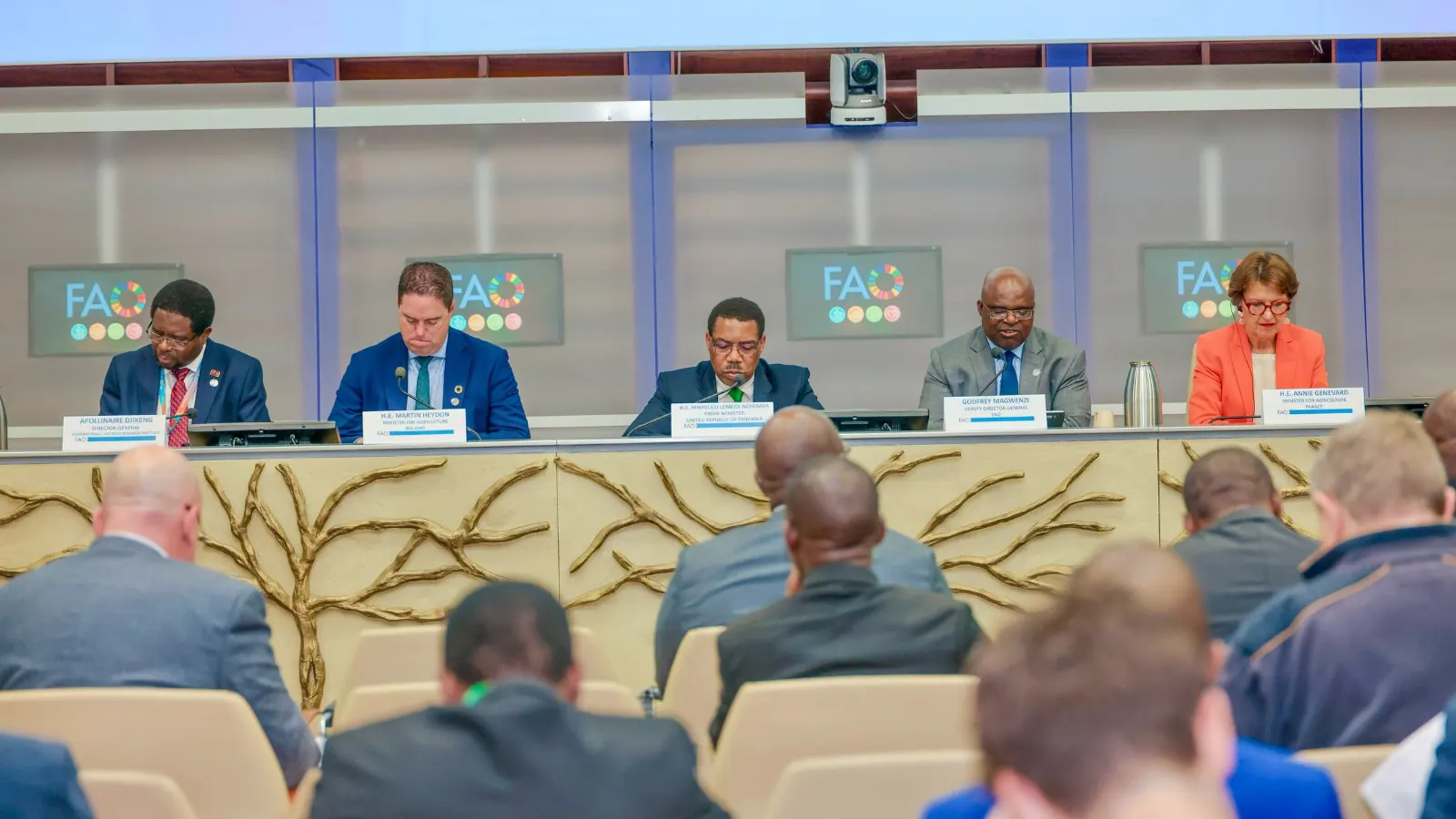
For millions of African families, livestock such as sheep and goats are a vital source of food, income, and savings. However, a highly contagious viral disease known as Peste des Petits Ruminants (PPR) is threatening these communities. To combat this, African leaders and international partners gathered at the Food and Agriculture Organisation (FAO) headquarters in Rome on September 22, 2026. The meeting aimed to move PPR eradication from a political commitment to financed implementation.
The high-level side event brought together the Prime Minister of Tanzania, ministerial representatives from Chad, Cameroon, Bangladesh, and Burkina Faso, as well as the World Bank, Bill & Melinda Gates Foundation, Intergovernmental Authority on Development (IGAD), European Union, African Union, and technical organisations working in animal health. Tanzania demonstrated how its political commitment is being translated into investment in vaccination, livestock identification, surveillance, and veterinary systems.
Prime Minister of Tanzania, Dr Mwigulu Nchemba, emphasised that transforming agrifood systems requires investment beyond production, including systems that protect people, animals, and ecosystems. He described PPR eradication as a practical example of the One Health approach, linking animal health with food security, rural livelihoods, and trade. Tanzania has already made progress in controlling PPR in cattle and is now focusing on sheep and goats.
According to Dr Nchemba, Tanzania has invested significantly in PPR eradication, with President Samia Suluhu Hassan launching a five-year national livestock vaccination and identification campaign in July 2025. The campaign is supported by over 260 billion Tanzanian shillings, equivalent to more than 86 million US dollars. During the 2025/26 financial year, the government vaccinated over 16.8 million sheep and goats against PPR.
Tanzania's approach goes beyond vaccination, with a focus on strengthening livestock identification and traceability, disease surveillance, laboratories, diagnostics, and veterinary services. The objective is to develop systems that prevent and detect disease rather than wait for outbreaks to occur. This approach is crucial, as PPR is a transboundary animal disease that can spread between countries through livestock movements.
The Rome discussion highlighted the need for regional cooperation to sustain national progress in PPR eradication. With over 70 countries confirming PPR within their borders, a global benefit-cost study estimated that a 15-year PPR eradication programme could generate discounted economic benefits of approximately 76.5 billion US dollars. The European Union announced an additional 50 million euros for a second phase of support to PPR eradication in Africa.
The meeting concluded with a call for countries to develop costed national investment plans and integrate them into national and regional financing frameworks. The World Bank, Bill & Melinda Gates Foundation, and other partners will support the mobilisation of investment for high-impact interventions. Chad and Cameroon shared their national experiences in vaccination, veterinary infrastructure, and services for pastoral communities.
Key points
- Tanzania has invested over 260 billion Tanzanian shillings in a five-year national livestock vaccination and identification campaign to eradicate PPR.
- The European Union announced an additional 50 million euros for a second phase of support to PPR eradication in Africa.
- A global benefit-cost study estimated that a 15-year PPR eradication programme could generate discounted economic benefits of approximately 76.5 billion US dollars.