The African startup ecosystem is facing a significant reckoning from the venture capital boom of 2021 and 2022. Hundreds of companies that secured early-stage funding during this period are now struggling to attract fresh investment, sustain expansion, or transition into profitable businesses. This funding drought has exposed a growing weakness in the continent's technology economy. Raising seed capital no longer guarantees access to subsequent investment, even for businesses with developed products, acquired customers, and established operations.
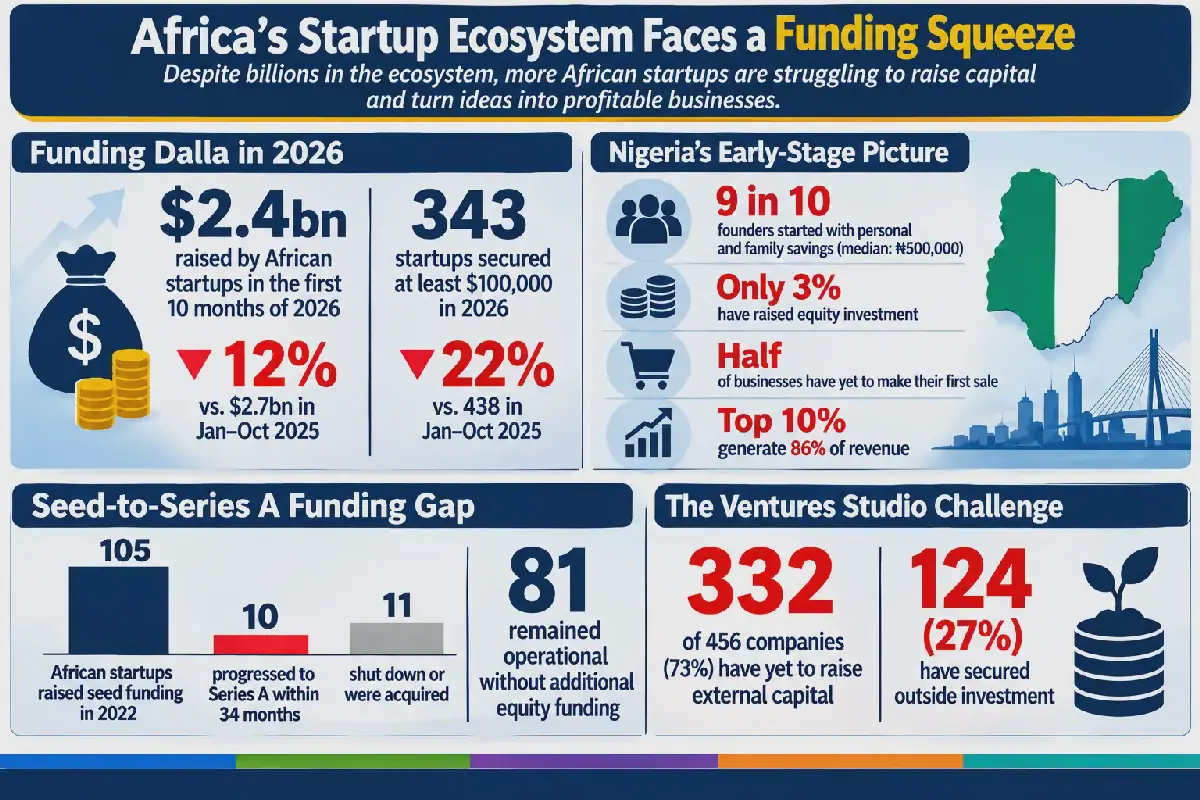
The decline in startup funding is evident in the numbers. African startups raised approximately $2.4 billion in the first ten months of 2026, representing a 12 percent decline from the corresponding period in 2025. The number of startups securing at least $100,000 fell 22 percent to 343, the lowest January-to-October figure since tracking began in 2021. This decline suggests that capital is increasingly concentrated among a smaller group of established businesses, making it difficult for early-stage founders to demonstrate traction.
A new study by Magna Collective analyzed over 24,000 early-stage businesses across Nigeria, finding that nine in 10 founders started their businesses with personal and family savings, with a median initial investment of just N500,000. Only three percent had secured equity investment, highlighting how most businesses are built without venture capital. Femi Awoniyi, managing partner at Magna Collective, noted that Nigeria does not have a shortage of founders, but rather a shortage of first customers.
The study also found that half of the businesses surveyed had yet to make their first sale, while the top 10 percent accounted for 86 percent of total revenue. This suggests that the funding crisis is not simply about investors withdrawing capital but also about the difficulty many businesses face in turning products into paying customers and generating consistent revenue. Awoniyi emphasized the need for a stronger bridge between starting a business and achieving steady sales, supported by paying customers, distribution networks, and suitable capital.
The consequences of this funding drought are becoming visible in markets such as Kenya, where several previously well-funded startups have collapsed or entered administration. Dealroom data showed that 13 venture-backed Kenyan companies that failed or entered administration had collectively raised approximately $718 million. Among them were Twiga Foods, Copia, Gro Intelligence, and KOKO Networks. Ecosystem analyses confirm that these collapses were largely driven by unsustainable scaling, high cash burn, and weak unit economics.
The shift in investment conditions has also changed how startup performance is assessed. Revenue growth, customer numbers, and geographical reach are no longer sufficient indicators of business strength when companies cannot demonstrate a credible route to profitability. Investors are increasingly scrutinizing cash burn, unit economics, operating efficiency, and the ability to generate revenue without relying on fresh capital. Cohort data compiled by Condia showed that of the 105 African startups that raised seed funding in 2022, only 10 had progressed to Series A within 34 months.
The findings point to a widening funding gap between companies that entered the market during the investment boom and the smaller pool of businesses now attracting institutional capital. Although many of these startups remain active, their inability to raise follow-on funding raises questions about their capacity to finance expansion, retain talent, and meet investor expectations without repeatedly returning to the market. Benjamin Dada, founder and publisher of Condia, noted that the cohort analysis challenges the perception that a recovery in aggregate funding necessarily translates into improved financing opportunities for startups across the continent.
Key points
- African startups raised $2.4 billion in the first ten months of 2026, a 12 percent decline from 2025.
- Only 3 percent of early-stage businesses in Nigeria had secured equity investment.
- 13 venture-backed Kenyan companies that failed or entered administration had collectively raised approximately $718 million.