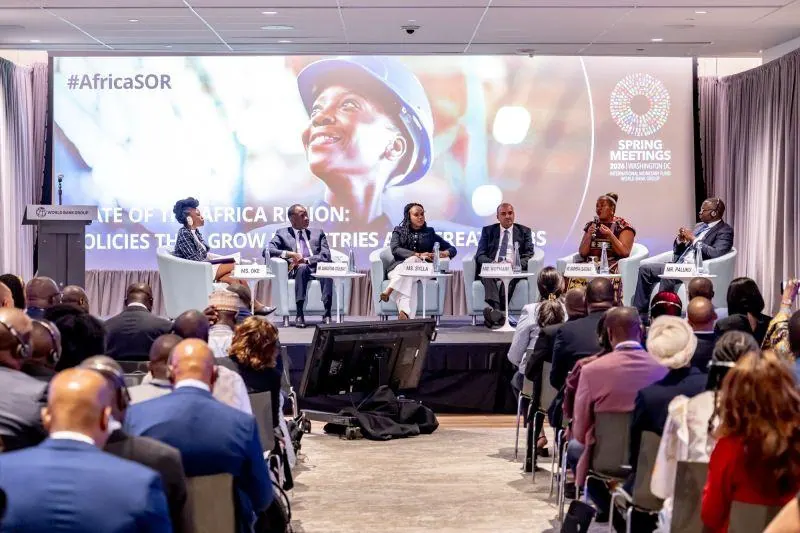
The World Bank has upgraded its economic growth forecast for Sub-Saharan Africa to 4.3 percent in 2026, up from 4.1 percent. This revised outlook reflects stronger-than-expected economic performance across the region. Growth forecasts have been upgraded for nearly three-quarters of countries, including Nigeria, Zambia, Ethiopia, and Angola. The improvement comes despite a challenging global environment marked by elevated energy prices and high interest rates.
The World Bank's latest Africa Economic Update, released on October 6, attributes the improved forecast to reforms and better economic management in several African economies. The significance of this growth extends beyond the headline figure, as it points to an expanding economic base. Governments are seeking to attract investment, strengthen domestic production, and create opportunities for a rapidly growing population.
However, the World Bank emphasizes that faster economic growth must translate into stronger household incomes and employment. Per capita income growth is expected to reach only 1.8 percent in 2026, highlighting the need for wider social gains. The World Bank is urging African governments to increase investment in artificial intelligence to improve productivity and create jobs.
Practical AI applications could help African economies without requiring enormous infrastructure investments. Potential applications include AI-assisted learning, tools to help farmers identify livestock diseases, and technologies that automate accounting tasks for small businesses. Shared data centers and stronger data-protection frameworks could also support wider adoption.
The World Bank sees an opportunity for Africa to approach AI as a practical development tool. Relatively affordable digital solutions could improve efficiency across agriculture, education, finance, and small enterprise. This approach could help millions of businesses operating with limited resources.
The latest growth forecast presents a broader message: Africa's economic story is one of resilience, reform, and technological opportunity. The challenge now is to convert stronger macroeconomic performance into better jobs, higher productivity, and more inclusive prosperity. As governments deepen reforms and businesses expand investment, the continent has an opportunity for durable economic transformation.
African Leadership Magazine recently announced winners for the 2025 African Business Leadership Awards. Mr. Khulekani Mathe will receive the African Leadership Award for Excellence in Economic Policy and Private Sector Advocacy. Dr. Kelly Oluoch and Mr. Mohamed Abdellahi Ould Yaha will also receive awards for their contributions to health and entrepreneurship.
Key points
- The World Bank has raised its 2026 growth forecast for Sub-Saharan Africa to 4.3 percent.
- Reforms and better economic management are driving stronger economic performance in several African economies.
- The World Bank is urging African governments to increase investment in artificial intelligence to improve productivity and create jobs.